Indigenous · History Classes · Grades 10–13 · College · University
Portals and CERN — The Gates of Heaven, and the Ring under the Border
History Class · Level band: Grades 10–13 · College · University
English edition — the language editions of the history classes are outstanding and will follow the site’s translation pattern; none is fabricated here.
OWNER'S TEACHING — the head of this class
Class: OWNER'S TEACHING. David's teaching (2026-10-28), standing as OWNER'S TEACHING, never flattened into the record:
(i) The identification (19:29; restated 20:53): “He may know the star system they came from but I know that they are fallen angels.” — the beings of the modern doctrines are fallen angels and their offspring, in the account of Noah.
(ii) Before All Worlds (19:29, restated 20:54): Yeshua is before all worlds, and there are other worlds beyond our own — no world, and nothing from any world, precedes or outranks Him.
Every ancient world in this history built heaven with gates, and named who kept them. The modern world built a ring of magnets under a border, and reached for the same word. The classes used throughout this class are those of the research file: DOCUMENTED (a text or record says it, at the source named) · DEBATED (the record carries both sides) · CLAIM (asserted, not evidenced) · OWNER'S TEACHING (David's own teaching, in his words, governing where he has ruled).
§1 — ENOCH'S PORTALS, AND JACOB AT BETHEL
DOCUMENTED. In 1 Enoch 72, the angel Uriel shows Enoch the laws of the luminaries, and the first law is stated as architecture (Charles translation, the owner's canon text):
“The luminary the Sun has its rising in the eastern portals of the heaven, and its setting in the western portals of the heaven. And I saw six portals in which the sun rises, and six portals in which the sun sets: and the moon rises and sets in these portals, and the leaders of the stars and those whom they lead: six in the east and six in the west, and all following each other in accurately corresponding order: also many windows to the right and left of these portals.” (1 Enoch 72:2–3)
DOCUMENTED. The sun then works the system — thirty mornings through the fourth, great portal in the first month, and portal by portal through the year as the day lengthens and shortens in measured parts; the moon is given its law in the chapters that follow, in the same portals. The heavens in this book are not open space. They are a built structure, with numbered doors in the east and numbered doors in the west, and nothing crosses except through its appointed gate, in its appointed season. The calendar that rides on those portals stands in full in The Heavens They Knew.
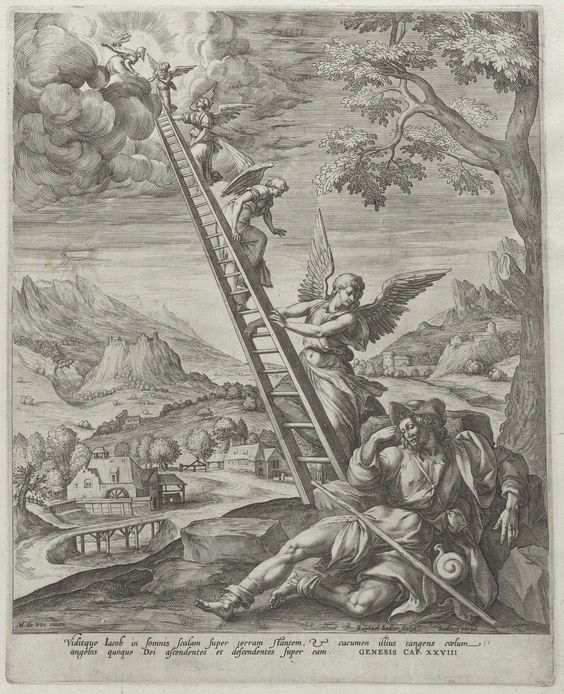
DOCUMENTED. Genesis 28: Jacob, fleeing to Haran, dreams of a ladder — or stairway — set on the earth, its top reaching to heaven, the messengers of Elohim ascending and descending on it (Gen 28:12). He wakes and names the place from what he has seen:
“Surely Yahweh is in this place; and I knew it not. … How dreadful is this place! This is none other but the house of Elohim, and this is the gate of heaven.” (Gen 28:16–17, in the collection's rendering)
DOCUMENTED — the word beside the rendering. The Hebrew is šaʿar haššāmayim, “gate of heaven” — šaʿar is the ordinary word for a city gate, the place of entrance and judgment. The scholarly record notes that the dream-object, sullām — a word found only here — is most plausibly a stairway or ramp, and that Jacob's naming makes Bethel itself the gate: heaven has a gate, and the gate has an address — a stone, anointed with oil (Gen 28:18–22).
§2 — EGYPT, MASHU, ADAPA, AND THE GATES OF DREAMS
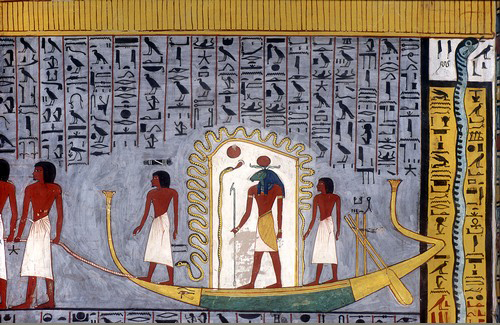
DOCUMENTED. Egypt's Book of Gates — a New Kingdom underworld book, the Amduat's cousin-text — divides the sun god Ra's night journey through the Duat into twelve hours, and at the end of each hour stands a gate, sebekhet. Each gate is kept: a guardian serpent on the door, and two further guardians with terrifying names and fire-spitting uraei; the company of the barque must know the gate and its keepers to pass. Only Sia (perception) and Heka (effective power) ride with Ra through the whole journey. At the end of the fifth hour stands the book's centrepiece, the judgment hall of Osiris, immediately before Ra's midnight union with Osiris's corpse, from which the sun is reborn toward dawn.
DOCUMENTED — where it stands. The book appears first in the tomb of Horemheb and thereafter in the royal tombs of the 19th and 20th Dynasties; the earliest complete version is on the alabaster sarcophagus of Seti I (c. 1290–1279 BC), with full versions also for Ramesses I and their successors. Its composition date is DEBATED — a Middle Kingdom origin proposed by some, composition under Amenhotep III favoured in the standard summaries. The system is not debated: in Egypt, even the sun does not pass through the night unchallenged.
DOCUMENTED. In Tablet IX of the Epic of Gilgamesh, the hero comes to Mount Mashu, whose twin peaks abut the fabric of the heavens and whose bases reach down to the underworld. Scorpion-men guard its gate — a pair, the scorpion-man and his wife — “whose terror was dread and glance was death,” who “at both sunrise and sunset guard the sun.” They question Gilgamesh, recognise the flesh of the gods in him — “two-thirds of him is a god, one-third is human” — warn him no mortal has crossed, and open the gate. Beyond it lies the road of the sun: twelve leagues of dense darkness, which he must outrun before the sun itself follows.
DOCUMENTED — beside it, Adapa. Adapa of Eridu, summoned before Anu for breaking the South Wind's wing, is met at the gate of Anu by its two keepers, Tammuz and Gishzida. Questioned for whom he wears mourning, he names the keepers themselves as the gods missing from the land; they laugh, intercede, and speak for him to Anu. He then refuses the food and water offered — which prove to be the food and water of life — and returns to earth mortal. At heaven's gate, as at Mashu, how you answer the keepers decides what happens next.
DOCUMENTED. Greece gives the gates to dreams. Penelope, in Odyssey 19: “Two are the gates of shadowy dreams: one is fashioned of horn and one of ivory. Such dreams as pass through the portals of sawn ivory are deceitful, and bear tidings that are unfulfilled. But the dreams that come forth through the gates of polished horn bring a true issue.” The passage turns on wordplay English cannot carry — keras, horn, against kraínō, I fulfil; elephas, ivory, against elephaíromai, I deceive.
DOCUMENTED, and DEBATED at its close. Virgil borrows the image at the end of Aeneid 6: twin gates of Sleep — horn, by which true shades pass easily, and shining ivory, through which the dead send false dreams upward. Anchises then dismisses Aeneas and the Sibyl — living travellers, not dreams — through the ivory gate. Why has never been settled; the enigma stands in the record as DEBATED.
The pattern, stated once. Enoch's heaven counts its doors — six and six. Jacob names a place on earth the gate of heaven. Egypt walls the night into twelve gated hours and names every keeper. Mesopotamia sets a scorpion pair on the sun's own road and two gods on Anu's door. Greece sorts even dreams by the gate they came through. Every ancient world built heaven with gates, and named who kept them.
§3 — CERN AT ITS DOCUMENTED HISTORY — AND ITS OWN WORD, “PORTAL”
DOCUMENTED. CERN, the European Organization for Nuclear Research, was founded by convention among twelve founding states — Belgium, Denmark, France, the Federal Republic of Germany, Greece, Italy, the Netherlands, Norway, Sweden, Switzerland, the United Kingdom and Yugoslavia. The Convention, signed in Paris in 1953, entered into force on 29 September 1954. Its site is at Meyrin, outside Geneva; the laboratory straddles the Franco-Swiss border. Its Convention binds it to research “of a pure scientific and fundamental character,” with no concern with work for military requirements, and results published or made generally available.
DOCUMENTED — the machines in their dates. The Proton Synchrotron first accelerated protons in November 1959, reaching 24 GeV on the night of 24–25 November 1959 — briefly the world's highest-energy accelerator; it still feeds the later complex. LEP, the Large Electron–Positron Collider, began operation in 1989 in a 27-kilometre ring under the border — the tunnel the LHC now occupies — and ran until 2000. The LHC's first beam circulated on 10 September 2008. Nine days later, on 19 September 2008, a faulty electrical connection between two magnets caused a quench: about six tonnes of helium were released into the tunnel and 53 magnets were damaged; CERN's published analyses (October and December 2008) confirm the faulty connection as the cause, and beams did not circulate again until November 2009. That is the documented engineering record of the machine's failure, printed in full. On 4 July 2012 the ATLAS and CMS collaborations announced a new boson of about 125 GeV, consistent with the Higgs boson — the particle the press calls the “God particle,” a nickname from the title of a 1993 book, generally disliked by physicists. A real history of real science: a post-war act of European cooperation, a succession of rings, and results published to the world.
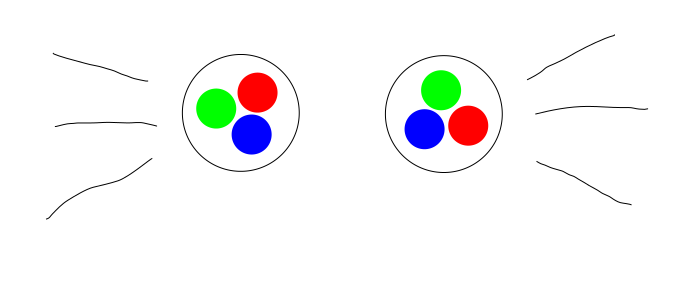
DOCUMENTED — the vocabulary, in its real sense, printed first. Large extra dimensions: theories from the late 1990s hypothesise additional spatial dimensions in which gravity alone propagates — a proposal the LHC collaborations have searched for in published analyses, with published null results and limits. In the literature the phrase means extra dimensions of space in the equations — not a doorway, and not a world that can be entered. The “Higgs portal”: a named term of the theoretical literature for a class of coupling scenarios in which the Higgs field connects the ordinary sector to a hypothesised hidden sector — a term in an equation, searched for through Higgs decays. The portal is a coupling, not a passage. The safety reviews: the LHC Safety Assessment Group reported in 2003 and again in 2008 that there is no basis for any conceivable threat from the LHC — on microscopic black holes, its argument is empirical: cosmic rays have made more energetic collisions on Earth and on dense stars for billions of years, and neutron stars and white dwarfs survive; any black holes made at the LHC are expected to decay by Hawking radiation effectively at once.
The word “portal” belongs to physics first, in that narrow, published sense. §6 borrows it. The borrowing is visible precisely because the real usage is printed here first.
§4 — THE STATUE AT ITS RECORD
DOCUMENTED. On 18 June 2004 a two-metre statue of Shiva as Nataraja, Lord of the Dance, was unveiled at the laboratory — a gift of India's Department of Atomic Energy, marking India's long association with CERN since the 1960s. A plaque beside it explains the choice through Fritjof Capra's The Tao of Physics: Ananda Coomaraswamy's line that the Nataraja is “the clearest image of the activity of God which any art or religion can boast of,” and Capra's — that the rhythm of creation and destruction “is also the very essence of inorganic matter,” so that “for the modern physicists, then, Shiva's dance is the dance of subatomic matter.” The statue's stated meaning at the laboratory is on its plaque, in words: a metaphor, chosen deliberately.
DOCUMENTED — the dance in its own tradition, in its own terms. In the tradition of Chidambaram, where Shiva dances the dance of bliss, the Nataraja's form performs the five acts (pañcakṛtya): creation — from the drum; preservation — from the hand raised in the gesture of fearlessness; destruction — from the flame; veiling — the foot planted on forgetfulness, reality concealed and the soul at rest within it; and grace — the lifted foot, to which the fourth hand points: release for the soul that approaches. “Creation arises from the drum: protection proceeds from the hand of hope: from fire proceeds destruction: the foot held aloft gives release.”
The statue stands in the record as what it is — all three, unmerged: a diplomatic gift; a metaphor chosen by physicists, printed on its own plaque; and a sacred image of a living religion, whose meaning in its own tradition is the five acts above. No photograph of the statue is carried in this class: the laboratory's photographs are generally CC BY and no photograph could be verified as strictly public domain or CC0 — see OWED.
§5 — THE TWO 2016 EVENTS — SEPARATE, AND KEPT SEPARATE
The separation is part of the lesson. The two events in this section happened in the same summer, in the same country. At the record they have no other connection: different places, different institutions, different works. The circulation merges them. This history does not.
(a) The staged video at the statue — the laboratory, Meyrin, August 2016
DOCUMENTED — what stands independently. In August 2016 a night video circulated: cloaked figures before the Nataraja statue, a woman in white on the ground, a staged “stabbing,” and a filmer who swears and flees. The independent reporting (Agence France-Presse, 17–18 August 2016) establishes at its own weight: the scenes were filmed on the laboratory's premises, and the persons involved held legitimate site access badges. The one statement in the record from outside the institution is the Geneva police position, given to AFP: they had been in contact with CERN about the video but were not involved in an official investigation.
CERN'S OWN STATEMENT — attributed to CERN. Everything further is the laboratory's account of an event on its own premises: that the scenes were filmed without official permission or knowledge; that the video is a “spoof” and, in its FAQ's word, “fiction”; that the badge-holders were scientific users who, in its spokeswoman's words, “let their humour go too far”; that the laboratory does not condone it; and that the investigation was an internal matter. This class does not present that account as a neutral resolution: an institution's statement about itself is evidence of what the institution says. No body outside CERN has adjudicated what the video was, and the persons involved were never publicly named by the laboratory. The words “spoof,” “fiction” and “prank” are printed here as CERN's own characterisation, at exactly that weight.
CLAIM. The surviving sinister readings — a real sacrifice, a filmer killed or silenced — are carried at CLAIM: no artefact, document or named witness at standard supports any of them. The reading that the laboratory's statement is itself a cover is likewise a reading, not a finding; what this class states as its own is the narrower point printed above: the only published account of the video's nature is the institution's own, never independently adjudicated.
(b) The Gotthard Base Tunnel opening — Erstfeld and Bodio, 1 June 2016 — NOT the laboratory
DOCUMENTED. On 1 June 2016, ten weeks before the video above, Switzerland opened the Gotthard Base Tunnel — at 57 kilometres the world's longest railway tunnel, after about seventeen years of construction and at the cost of nine workers' lives, who are commemorated at the work. Its portals are at Erstfeld and Bodio — over 200 kilometres from the laboratory at Meyrin. A different work, built by a different institution, in a different part of the same country.
DOCUMENTED. The opening, before the Swiss Federal Council and neighbouring heads of government, centred on a large directed theatrical performance — Sacre del Gottardo, directed by Volker Hesse, with some 600 performers: a choreographed pageant of alpine myth and alpine labour — tunnel workers, the mountain's spirits and goat-figures of the alpine ibex, industry, death and rebirth — performed as public theatre for a state opening. Footage of this pageant is the footage most often circulated as if it were footage of the laboratory. It is not.
Same summer, same country, no other connection at the record. Keep the entries apart, and the merge in §6 can be seen happening — and refused.
§6 — THE MODERN STARGATE DOCTRINE
CLAIM — the doctrine, at its class throughout. The modern teaching holds, in substance: that the ancient gates were machines — physical, ring-shaped portal devices through which beings passed bodily between worlds; that such a device stood in Iraq — beneath or near Babylon, beneath a palace, or at the Great Ziggurat of Ur, the tellings differ; that the 2003 invasion of Iraq had that device as its true object, the publicly stated grounds serving as cover for seizing it; and that states now hold or seek such gates — the great collider itself, in stronger tellings, being used to open one.
CLAIM — at every load-bearing point. No artefact of a portal device has been produced, in Iraq or anywhere. No document places a gate among the objects of the 2003 war. No named witness at standard testifies to a state portal programme. The ziggurat at Ur is a documented solid temple platform of c. 2100 BC, with no interior chamber for a device to stand in. The doctrine is therefore CLAIM throughout — while it is DOCUMENTED that the doctrine itself is taught, published and widely circulated, with a literature and a lineage. Its vocabulary is borrowed, and §3 printed the originals first: the ancient gates re-read as hardware; “extra dimensions” and “Higgs portal” detached from the equations that fix their meaning; and the ring-gate image itself, taken from modern screen fiction. Its method is the merge exposed in §5: a railway pageant circulated as a laboratory ritual, the staged video circulated as a sacrifice, a gift statue circulated as an altar.
The chapter, placed. The ancient texts' gates were heaven's architecture in story and liturgy — doors that organised the sun's year, the night's journey, the dream's truth, the traveller's questioning. The modern doctrine re-reads them as hardware. Between the two stands the laboratory, which uses “portal” for a coupling in an equation and built, instead of a gate, a ring that collides protons and publishes what it finds. The ring under the border is real. The gates of heaven are in the texts. Each stands where the record puts it. The beings of the neighbouring doctrines stand where the owner's teaching, and the record of the Watchers, put them: see The Watchers in the Texts and Before All Worlds.
OWNER'S TEACHING, governing this section, unmerged. David's identification stands in his words:
“I don't believe in aliens. I believe they're fallen angels in the account of Noah.” — and, restated for the star-system teachings: “He may know the star system they came from but I know that they are fallen angels.”
OWNER'S TEACHING. In his teaching, the beings the doctrine expects through its gates are the fallen angels of the Noah account and their crossbred offspring. And his Before All Worlds teaching closes the class as it opened it: Yeshua is before all worlds, and there are other worlds beyond our own — no world, and nothing from any world, precedes or outranks Him. A gate, if there were a gate, would open under that order, not above it.
OWED / NOT CARRIED, in brief
An honest gap stands as a gap. Nothing in this register is filled by inference.
- Photograph of the Nataraja statue — OWED. The laboratory's own photographs are generally CC BY, and no Commons photograph of the statue could be verified as strictly public domain or CC0 on its holding file page. The standard is not lowered; the statue is carried at its documented record (§4) without an image, and none is hotlinked.
- LHC ring / accelerator-complex diagram — OWED. The ring, location and complex diagrams checked are CC BY-SA or CC BY 4.0, failing the strictly-PD/CC0 standard. A verified public-domain generic collision schematic is carried instead (§3), captioned as a schematic — not as the ring.
- Book of Gates, Seti I version, photograph — OWED in that form. The circulated Seti I renderings are CC BY 4.0. The verified public-domain Ramesses I (KV16) barque image is carried instead (§2), captioned exactly.
- LSAG reports and Higgs-portal literature are stated at their conclusions and characterised, not quoted or catalogued at length; verbatim annexes are owed before any typeset quotation.
- The staged video itself — never carried. Described at §5(a) only; no frame, still or link is carried in this strand.
Sources
Primary texts and standard editions: 1 Enoch 72–74 (Charles translation, the owner's canon text) · Genesis 28 · the Book of Gates at standard Egyptology (Hornung's edition; the Global Egyptian Museum summary) · Epic of Gilgamesh, Tablet IX (standard version) · the Adapa myth (Nineveh and Amarna fragments) · Homer, Odyssey 19.560–569 · Virgil, Aeneid 6.893–898.
The laboratory, the statue, and 2016: the CERN Convention and founding record (1954; twelve founding states) and the laboratory's machine history (PS 1959 · LEP 1989 · LHC first beam 10 September 2008 · Higgs announcement 4 July 2012) · the LHC Safety Assessment Group reports, 2003 and 2008 · the Higgs-portal and large-extra-dimension literature at its named terms · the unveiling record of 18 June 2004 and the statue's plaque (Capra, The Tao of Physics) · Coomaraswamy, The Dance of Shiva, for the five acts · Agence France-Presse reporting of 17–18 August 2016 for the filmed-on-premises facts, CERN's own account of the staged video, and the Geneva police position · CERN's published analyses of October and December 2008 for the 19 September 2008 incident · the Gotthard Base Tunnel opening record, 1 June 2016, and the production reporting for Sacre del Gottardo (director Volker Hesse, 600 performers). Attributions for the modern doctrine stand in the research file's Research log only, per the strand's method.
Read beside this class: The Heavens They Knew · The Watchers in the Texts · Before All Worlds · The Table · Chronology
Record: PORTALS_AND_CERN_2026-10-28.md (study_materials/world_history) — classes carried unchanged; the two 2016 events kept separate throughout.