Indigenous · History Classes · Grades 10–13 · College · University
The Tablets Speak — The Anunnaki in the Cuneiform Record
History Class · Level band: Grades 10–13 · College · University
English edition — the language editions of the history classes are outstanding and will follow the site’s translation pattern; none is fabricated here.
OWNER'S TEACHING — the head of this class
Class: OWNER'S TEACHING. David's settled identification of the modern doctrines built on this material (2026-10-28), standing as OWNER'S TEACHING, never flattened into the record:
“I don't believe in aliens. I believe they're fallen angels in the account of Noah.”
In his teaching, the beings of the modern retellings of these tablets are the fallen angels — the Watchers of the Noah account — and their crossbred offspring. That identification is his; the record in this class is the tablets' own, in which the Anunnaki are gods and the Watchers, in his canon, are angels who fell (see Watchers in the Texts and Before All Worlds). The two literatures stand on adjoining ground; their identities are kept as each text gives them. The classes used throughout this class are: DOCUMENTED (a text or record says it, at the source named) · DEBATED (the record carries both sides) · CLAIM (asserted, not evidenced) · OWNER'S TEACHING (David's own teaching, in his words, governing where he has ruled).
§1 — MANKIND'S ACCOUNT OF ITSELF, IN CLAY
DOCUMENTED. Before there were books there were tablets. In the river plain between the Tigris and the Euphrates, scribes pressed a cut reed into wet clay and wrote, in wedge-shaped signs, the oldest account mankind possesses of its own beginning: where the gods stood, why human beings were made, why they work, why they multiply, and why the waters once rose over everything.
DOCUMENTED. That account was then lost to the world for more than two thousand years. The languages died; the script became unreadable; the tablets slept in ruined libraries under the mounds of Iraq. What is recovered in this class is the account itself, read again at first hand in the standard editions: the great gods called the Anuna — in Akkadian, the Anunnaki — decreeing fates in assembly; the lesser gods labouring and rising in revolt; mankind mixed from clay and the flesh and blood of a slain god to bear that labour in their place; the noise of a multiplying people; the plagues; the flood sent and survived; and, after it, a king list that counts the years before the flood in tens of thousands and then says, in five words, “then the flood swept over.”
§2 — THE WORD
DOCUMENTED. The name is Sumerian ᵈa-nuna, ᵈa-nun-na — rendered in the Electronic Text Corpus of Sumerian Literature (ETCSL, Oxford) consistently as “the Anuna gods.” The Akkadian form is Anunnaki / Anunnaku.
DOCUMENTED. The dictionaries give the word's sense as offspring of the sky-god: Black & Green — “princely offspring”; Leick — “those of royal blood”; the scholarly analysis behind them, “offspring / seed of the prince” — the descendants of An, head of the pantheon, “father of the gods.”
DEBATED, at the margin only. The precise internal analysis of the word is debated in detail. What is not found in any dictionary or corpus is a verbal phrase in the word — no coming, no descent, no journey from heaven to earth is written in it. The word names a lineage, not an arrival.
DOCUMENTED. The first attestations stand in inscriptions of Gudea of Lagash (c. 2144–2124 BC) and of the Third Dynasty of Ur (c. 2112–2004 BC), for the most powerful deities, the descendants of An. The great scribal god list An = Anum runs seven tablets and almost 2,000 divine names — and never produces a fixed Anunnaki roster. The tradition that catalogued two thousand gods left no single membership list for this one company, because the word names the great gods collectively, as a text's context requires.
§3 — WHO THE ANUNNAKI ARE IN THE TEXTS
DOCUMENTED. Across the compositions, the Anuna are a collective of gods — not a species, a crew, or a population in any text. Their functions shift with the composition, and the compositions are not harmonised here:
- They decree fates and sit in the divine assembly. In Atrahasis the assembly that answers “yes” to mankind's making is “the great Anunnaki who assign the fates.” In Enki and the World Order (ETCSL c.1.1.3) they stand in prayer and supplication, dwell in Sumer's cities, consume food in its shrines, and “determine the destinies” among its people, under Enki, “leader of the Anuna gods… firstborn son of holy An.”
- They impose labour — in Atrahasis they are the great gods on whose behalf the lesser gods work (§5).
- They are divided between heaven and the netherworld. In Enuma Elish VI, Marduk “divided the gods, all the Anunnaki into upper and lower groups; he assigned 300 in the heavens to guard the decrees of Anu… In heaven and netherworld he stationed 600 gods.” Recensions phrase the division differently, and the figures are stable only as hundreds, divided above and below.
- They judge the dead. In Inanna's Descent to the Nether World (ETCSL c.1.4.1), the goddess, stripped at the seven gates, takes Ereshkigal's throne, and:
“The Anuna, the seven judges, rendered their decision against her. They looked at her — it was the look of death… The afflicted woman was turned into a corpse. And the corpse was hung on a hook.”
DOCUMENTED — numbers, per text, never harmonised. Seven: the great Anunna burdening the Igigi in Atrahasis I (Foster prints “(?)” after the number), and — a different seven — the underworld judges of Inanna's Descent; seven-and-seven: the fourteen pieces of clay of Atrahasis, seven males and seven females; ten: the Igigi in their original Old Babylonian sense, an Igigi count, not an Anunnaki one; fifty: the Anuna of Eridu, and — separately — the fifty great gods of Enuma Elish's assembly and Marduk's fifty names; three hundred and six hundred: the stations of Enuma Elish VI. No text gives one number for the company as a whole.
§4 — THE IGIGI, AND THE SHIFT OF THE NAMES
DOCUMENTED. Igigi is a term introduced in the Old Babylonian period as a name for the “great gods.” In Atrahasis the relation is functional and sharp: the Anunnaki are the great gods who impose the work; the Igigi are the gods who do it — digging the watercourses, the canals, the beds of the Tigris and the Euphrates, opening springs and wells, heaping up mountains — until they revolt and are replaced by man (§5).
DOCUMENTED. Elsewhere the terms overlap from early on — Enuma Elish, Erra and Anzu already sort “the Igigi of heaven and the Anunnaki of the Apsû.” From Middle Babylonian times onward, Akkadian usage generally applies Igigi to the gods of heaven collectively and Anunnaki to the gods of the underworld — the drift that gives the Anunnaki their later netherworld colouring, visible again in the 8th-century BC Poem of Erra, where they appear as brothers of Nergal. That later colouring is not the Sumerian starting point, where the Anuna are heavenly, fate-decreeing great gods.
§5 — ATRAHASIS, WHOLE
DOCUMENTED. Atrahasis — the name means “exceedingly wise” — is an Akkadian composition whose main surviving recension was copied in the reign of Ammi-saduqa, 17th century BC, by the scribe Ipiq-Aya. It is the fullest single telling of the whole arc, and it is carried here whole.
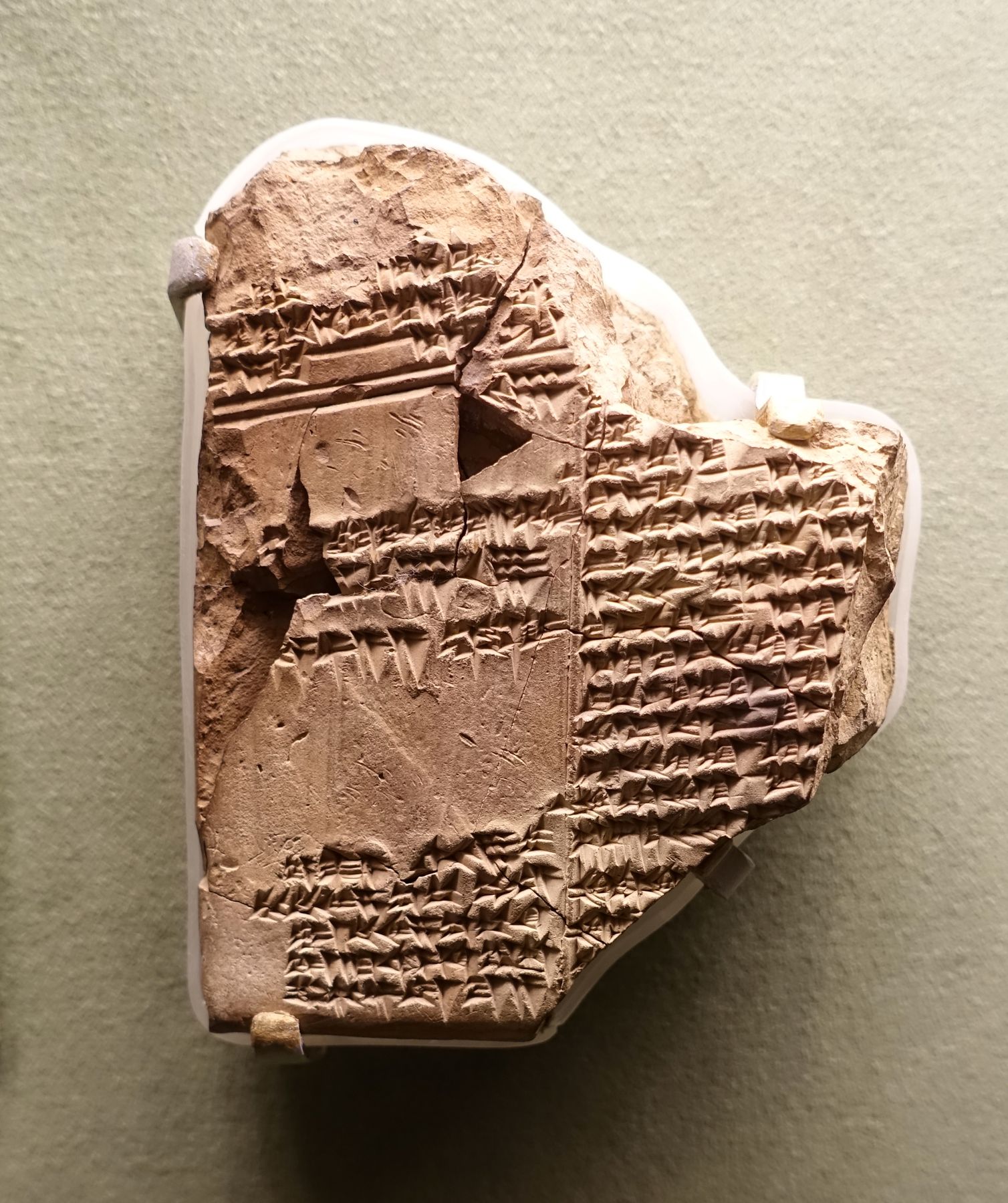
1 · A tablet of Atrahasis itself. A fragment of the Babylonian flood story, the Epic of Atrahasis, in Akkadian cuneiform on clay — First Dynasty of Babylon, reign of King Ammi-saduqa, c. 1646–1626 BC; Morgan Library & Museum, MLC 1889; photograph public domain (CC0) via Wikimedia Commons. What it shows: one surviving fragment of the Old Babylonian poem of §5, of the same recension the standard edition rests on. What it does not show: the poem whole — Atrahasis is assembled from many such fragments, and no single tablet carries it entire.
The labour. DOCUMENTED. The poem opens when the gods did the work themselves: “When the gods instead of man did the work, bore the loads, the gods' load was too great, the work too hard, the trouble too much. The great Anunnaki made the Igigi carry the workload sevenfold” (Dalley). The work, line after line, is irrigation corvée — canals, watercourses, river beds, wells, marsh excavation, under a canal-controller. In Foster's text the Igigi bear it forty years.
The revolt. DOCUMENTED. The Igigi complain, burn their tools, and march en masse by night on Enlil's house, surrounding his gate. Enki defends them before the assembly — “Their forced labor was heavy, their misery too much!” — and proposes the substitute: a new being to bear the yoke in their place.
The making. DOCUMENTED — the centre of the tablet record, Lambert & Millard's edition, Tablet I, in Dalley's rendering:
“Then one god should be slaughtered. And the gods can be purified by immersion. Nintu shall mix the clay with his flesh and blood. Then a god and a man will be mixed together in clay. Let us hear the drumbeat forever after. Let a ghost come into existence from the god's flesh, let her proclaim it as her living sign, and let the ghost exist so as not to forget the slain god.”
“They answered ‘yes’ in the assembly, the great Anunnaki who assign the fates… Geshtu-e, a god who had intelligence, they slaughtered in their assembly. Nintu mixed clay with his flesh and blood. They heard the drumbeat forever after. A ghost [eṭemmu] came into existence from the god's flesh… After she had mixed that clay, she called up the Anunnaki, the great gods. The Igigi, the great gods, spat spittle upon the clay.”
DOCUMENTED. The slain god's name is read Geshtu-e in Dalley's rendering and Wê-ila in Lambert & Millard's; the text's own wordplay joins his ṭēmu, intelligence, to the eṭemmu, the ghost that remains in mankind. The birth-goddess — Mami, renamed for this work Belet-kala-ili, “Mistress of All Gods” — reports: “You have slaughtered a god together with his intelligence. I have relieved you of your hard work, I have imposed your load on man. You have bestowed noise on mankind. I have undone the fetter and granted freedom.” Then the forming: seven pieces of clay on the right, seven on the left, a mud brick between them — seven males, seven females — and at the tenth month the womb is opened. The created being is lullû, man as the substitute worker, bearing “the yoke, the task of Enlil,” so that the gods may rest. No gold, no mine, no metal and no distant mining land occurs in the passage; the labour mankind inherits is the canals.
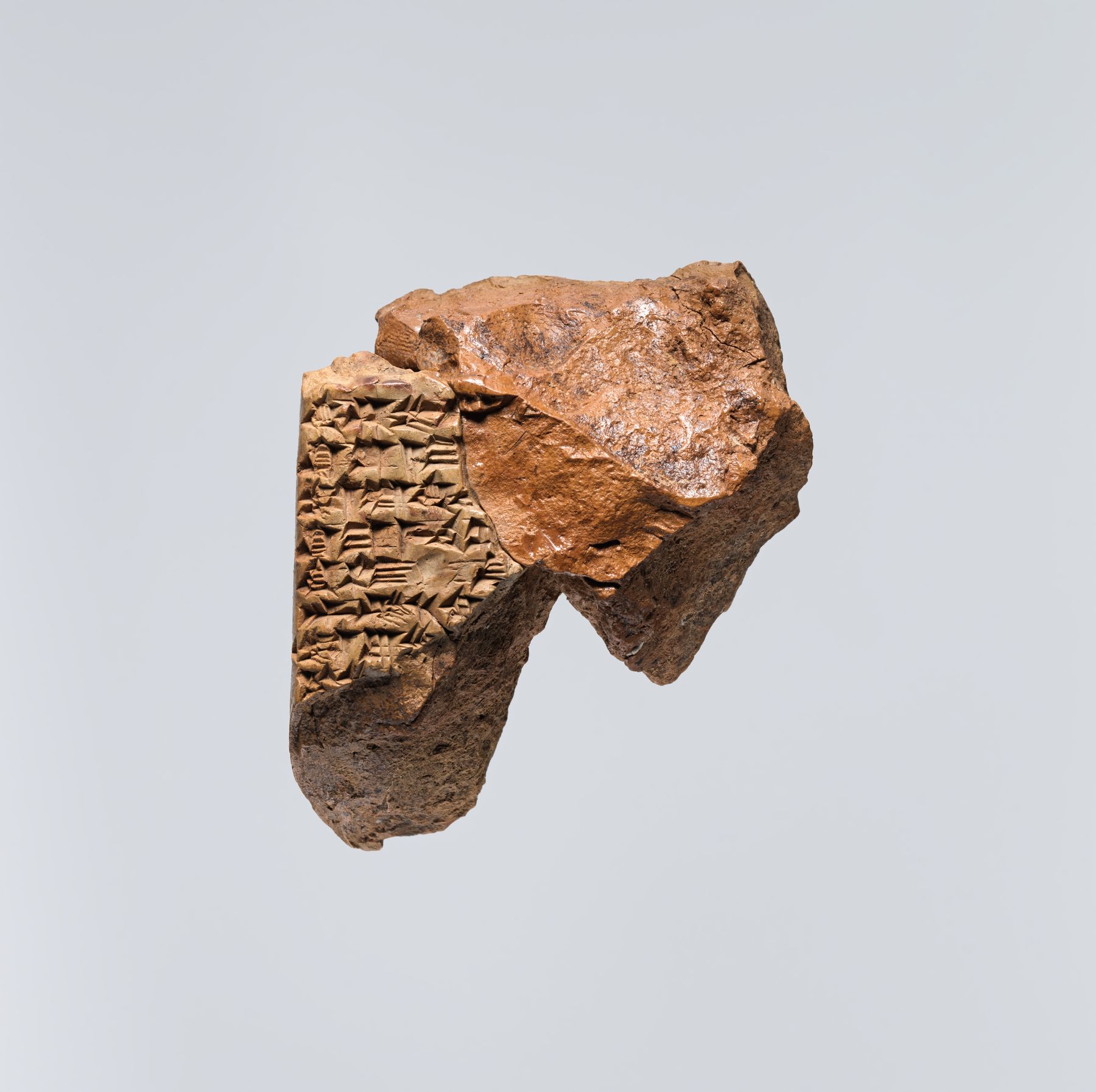
2 · The poem still being copied, a thousand years on. Cuneiform tablet fragment of Atra-hasis, the Babylonian flood myth — Neo-Babylonian or Achaemenid, ca. 7th–6th century BC, clay; the Metropolitan Museum of Art, 86.11.378a, Open Access (public domain, CC0). The Met's record: the front describes the noise on earth that led to the gods' decision; the reverse carries the story's end and the survivor's name. What it shows: the poem's long life in copies. What it does not show: the Old Babylonian original — this is a late copy of an already ancient text.
Birth, population, and the noise. DOCUMENTED. Mankind multiplies, and its noise grows with it — the poem's own word for a teeming, clamorous humanity, bestowed at the making and now disturbing Enlil's rest.
The plagues, and Enki's counsel. DOCUMENTED. At intervals Enlil moves against the multiplication: first plague, then famine and drought. Each time Enki counsels Atrahasis to direct the people's offerings to the one god responsible for that affliction, and each affliction is lifted. Enlil decrees the lessening; Enki, who proposed mankind's making, preserves it from inside the decree.
The flood sent. DOCUMENTED. At last Enlil binds all the gods by oath to a flood, and to secrecy. Enki, bound, does not speak to the man — he speaks to the man's reed wall, and Atrahasis, listening behind it, understands. He builds the boat, loads his family, the animals and the birds, and seals the door with bitumen.
The flood survived. DOCUMENTED. In the storm the gods themselves suffer it — “The great gods, the Annuna, stayed parched and famished. The goddess watched and wept…” — because with mankind destroyed the offerings have ceased. After seven days and nights the waters settle; Atrahasis offers sacrifice, and the hungry gods smell the savour and gather “like flies over the offering.” The birth-goddess swears by the flies of her necklace to remember these days.
The settlement after. DOCUMENTED. Enlil, finding a survivor, is furious. Enki answers openly — “I made sure life was preserved.” The resolution the text gives is not a covenant: from then on mankind's numbers are held down from within life itself — a pāšittu demon to snatch infants, and classes of women appointed who shall not bear. The poem ends where it began: the gods' rest secured, and mankind's labour and limits both fixed by decree. The same flood, in its other tellings and beside Genesis, stands in Flood Traditions.
§6 — ENUMA ELISH, IN BRIEF — AND THE OTHER MAKINGS
DOCUMENTED. Enuma Elish, the Babylonian creation epic in seven tablets, is a later composition — late 2nd millennium BC, its exact date DEBATED (c. 1100 BC is widely argued). Where Atrahasis begins with labour, this epic begins with war: Tiamat, the salt-water mother of the gods, rises against the younger gods; Marduk is armed and exalted by the assembly on condition of victory; he defeats her, splits her body to make heaven and earth, stations the gods above and below (§3), and turns to mankind.
DOCUMENTED. Marduk proposes it in Tablet VI: “Let me put blood together, and make bones too. Let me set up primeval man: Man shall be his name… The work of the gods shall be imposed on him, and so they shall be at leisure” (Dalley). Ea carries it out from the war's guilty party: “Qingu is the one who instigated warfare, who made Tiamat rebel and set battle in motion. They bound him, holding him before Ea; they inflicted the penalty on him and severed his blood-vessels. From his blood he created mankind, on whom he imposed the service of the gods, and set the gods free.” In this passage there is blood alone — no clay. The Anunnaki then labour themselves, once: they wield the pick for a year, make the bricks, and raise Esagila, Marduk's temple in Babylon — before the fifty great gods take their seats and Marduk's fifty names are proclaimed.
DOCUMENTED — the makings differ, and are not harmonised. Atrahasis: clay mixed with a slain god's flesh and blood, and the gods' spittle. Enuma Elish VI: Qingu's blood alone. Enki and Ninmah (ETCSL c.1.1.2): clay kneaded from the top of the Abzu alone, no slain god in the composite text — Namma waking the sleeping Enki to ask for “a substitute for the gods so that they can be freed from their toil” — and a second half of contested, flawed forms for whom fates must be found. KAR 4, from Assur: two slain Lamga gods (the name is also read Alla; the reading is uncertain in the editions) — “With their blood let us create mankind. The service of the gods be their portion, for all times.” One scholarly proposal, that a word rendered “clay/mud” in Enki and Ninmah should be read “blood,” stands DEBATED as a proposal; the published ETCSL and ORACC translations do not adopt it.
DOCUMENTED. One purpose clause runs through every version, whatever the material: mankind is made to do the gods' work so that the gods can rest. That sentence is the theological centre of the whole record.
§7 — THE FLOOD IN GILGAMESH
DOCUMENTED. The standard version of the Epic of Gilgamesh was compiled around c. 1200 BC, traditionally attributed to the scholar Sîn-lēqi-unninni, and its eleventh tablet carries Utnapishtim's first-person flood account — the form in which the flood story is best preserved. As the storm comes up, “the Anunnaki had to carry torches; they lit up the land with their brightness”; then, as it breaks:
“Even the gods were afraid of the flood-weapon. They withdrew; they went up to the heaven of Anu. The gods cowered, like dogs crouched by an outside wall. Ishtar screamed like a woman giving birth… ‘I myself gave birth to them, they are my own people, yet they fill the sea like fish spawn!’ The gods, the Anunnaki, wept with her.”
DOCUMENTED. The storm lasts six days and seven nights; the boat, loaded with “all my kith and kin… all the beasts and animals of the field and the craftsmen,” grounds on Mount Nimush; birds are released; sacrifice is offered and smelled by the gods; and the ending belongs to Gilgamesh alone — Utnapishtim and his wife are granted immortality by Enlil, an ending Atrahasis does not give its survivor.
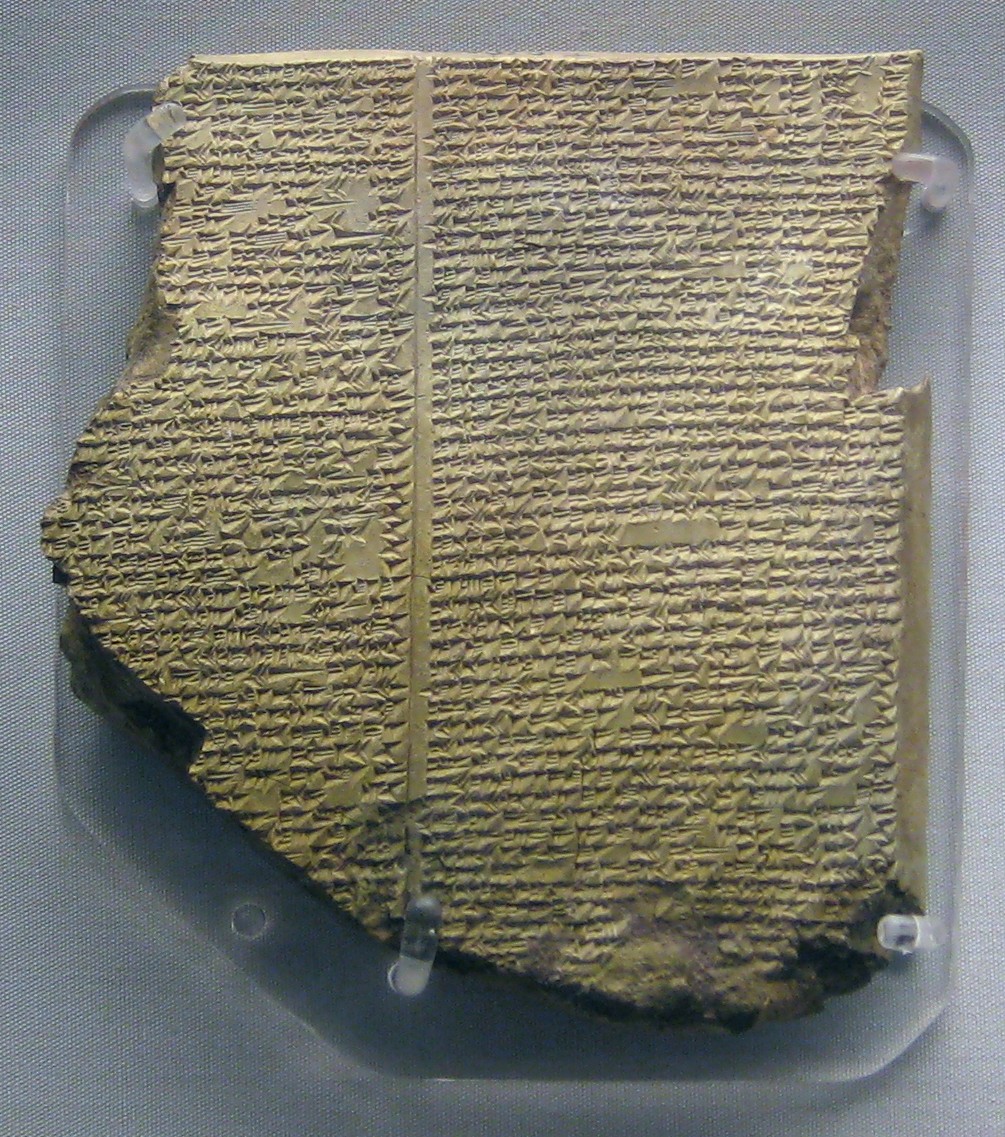
3 · The Flood Tablet. Tablet XI of the Epic of Gilgamesh, the story of the flood — Neo-Assyrian clay tablet, 7th century BC, from the Library of Ashurbanipal at Nineveh; British Museum (K 3375); photograph CC0 (public domain) via Wikimedia Commons. What it shows: the very tablet whose reading in 1872 (§9) returned the older flood to the world. What it does not show: a unique or earliest telling — older flood poems stand behind it (§5, §7), and this copy is itself a late copy in a royal library.
§8 — THE KING LIST, AT ITS FACE
DOCUMENTED. The Sumerian King List is a composition of the late third to early second millennium BC — copies run from the Ur III period into the Old Babylonian period, c. 2100–1800 BC in the range usually given for its composition and early copies. Some manuscripts lack the antediluvian section altogether; it is taken here at its face in the ETCSL composite text (c.2.1.1), as the texts give it — see also Chronology.
DOCUMENTED — at its face. The list opens: “After the kingship descended from heaven, the kingship was in Eridug. In Eridug, Alulim became king; he ruled for 28,800 years.” Then, city by city: Alalgar, 36,000 years, in Eridug; Enmenluana, 43,200, Enmengalana, 28,800, and Dumuzid the shepherd, 36,000, in Bad-tibira; Ensipadzidana, 28,800, in Larag; Enmenduranna, 21,000, in Zimbir; Ubara-Tutu, 18,600, in Šuruppag. “In 5 cities 8 kings; they ruled for 241,200 years. Then the flood swept over.” After the flood, kingship descends from heaven a second time, to Kiš — and the reigns, still large at first (1,200, 1,500, 900 years), step down across the list toward the lengths of remembered history. The figures stand exactly as the text gives them, built on the sexagesimal units of the scribal system (the šar of 3,600 and the ner of 600), neither explained away nor converted into anything else.
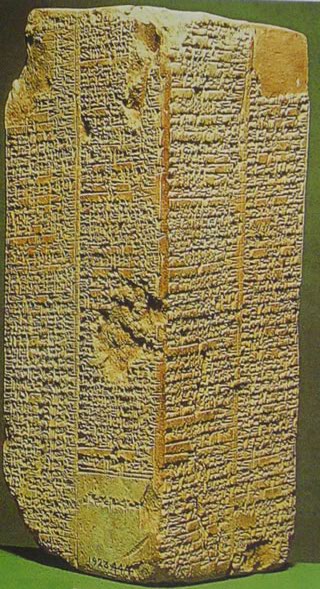
4 · The King List on clay. The Weld-Blundell Prism — a baked-clay prism inscribed in cuneiform with the Sumerian King List, from before the flood to Sin-magir of Isin; probably Larsa, c. 1827–1817 BC; Ashmolean Museum, AN1923.444; photograph public domain via Wikimedia Commons. What it shows: the most complete surviving copy of the list of §8, its four sides carrying two columns each. What it does not show: the list's only form — the King List survives in many copies, several without the antediluvian section, and this prism is not a flood tablet.
§9 — THE RECOVERY — AND HOW THE MATERIAL CIRCULATES TODAY
DOCUMENTED. The tablets came back to the world in the 19th century, out of the library of Ashurbanipal at Nineveh, excavated from 1849 onward and carried in tens of thousands of fragments to the British Museum. On 3 December 1872 the flood tablet — Gilgamesh XI — was read in translation before the Society of Biblical Archaeology in London, with the sitting prime minister among those present; the report ran in the newspapers the next day, and for the first time in more than two thousand years the older flood could be read beside the younger one.
DOCUMENTED. Atrahasis itself waited another century for its whole form. In 1969 the standard edition — Atra-Ḫasīs: The Babylonian Story of the Flood (Oxford: Clarendon Press) — assembled the Old Babylonian tablets, including the most complete copy, written by Ipiq-Aya in the reign of Ammi-saduqa in the mid-17th century BC, and gave the poem to the world as one work: labour, making, noise, plagues, flood and settlement together.
CLAIM — the signpost. This material now circulates far beyond the editions, in retellings that bend it. In the bent forms, the great gods become visitors from another world; the word that names their lineage is re-rendered as an arrival; a crossing-place among the stars becomes an unseen home planet on a vast orbit; the canals the Igigi dug become mines, and the gold that no line of Atrahasis mentions becomes the reason for mankind; the clay, the birth brick and the spittle become a laboratory, and the slain god's ghost in the flesh becomes a strand of code. Each bent element is a real line of the tablets, turned: the labour is real, the revolt is real, the making from a god's substance is real, the flood is real — and in the retelling each is given a mechanism the texts never name. The retold system stands at CLAIM as doctrine, and its load-bearing renderings do not survive the dictionaries and the texts themselves. The texts need none of it. A poem in which the gods go hungry inside their own flood, and crowd like flies to the first smoke of an offering, says more about the world that wrote it — and about the labour, the noise and the mortality it was explaining — than any mechanism laid over it. What was written in clay outlasted the empire that wrote it. It can be read, whole, as it stands.
OWED / NOT CARRIED, in brief
An honest gap stands as a gap. Nothing in this register is filled by inference.
- A complete roster of the Anunnaki — not carried, because none survives. No ancient text fixes the company's membership; the scribal god lists catalogue some 2,000 gods without isolating one roster (§2). Any fixed list presented anywhere is a modern assembly, not a tablet.
- The exact date of Enuma Elish's composition — DEBATED, not settled here. Late 2nd millennium BC is the range; c. 1100 BC is argued, not established.
- A witness-by-witness collation of the King List's antediluvian section — OWED. This class carries the ETCSL composite at its face; several manuscripts lack the section.
- The route of transmission between the Mesopotamian flood traditions and Genesis — DEBATED, carried open in the companion Flood Traditions class; this class decides neither direction.
- A public-domain photograph of an Enuma Elish tablet — OWED. None could be PD-verified for this page in this pass; §6 carries no image rather than a substitute.
- The slain god's name in Atrahasis is carried in both readings (Geshtu-e / Wê-ila), not resolved; the editions differ.
Sources
Primary texts and standard editions named in the text: ETCSL (Oxford) c.1.1.2 (Enki and Ninmah) · c.1.1.3 (Enki and the World Order) · c.1.4.1 (Inanna's Descent to the Nether World) · c.2.1.1 (the Sumerian King List) · Stephanie Dalley, Myths from Mesopotamia (Oxford, rev. 2008) — Atrahasis, Enuma Elish VI, Gilgamesh XI · W. G. Lambert & A. R. Millard, Atra-Ḫasīs: The Babylonian Story of the Flood (Oxford: Clarendon Press, 1969) · Benjamin R. Foster, Before the Muses / From Distant Days · Black & Green, Gods, Demons and Symbols of Ancient Mesopotamia (British Museum Press, 1992) · Gwendolyn Leick, A Dictionary of Ancient Near Eastern Mythology · the ORACC / Ancient Mesopotamian Gods and Goddesses project · KAR 4 (bilingual, Assur) · the god list An = Anum · the Weld-Blundell Prism (Ashmolean Museum AN1923.444).
Images: 1 · Atrahasis fragment, Morgan Library & Museum MLC 1889 — photograph by Daderot, CC0 1.0 Public Domain Dedication, via Wikimedia Commons. 2 · Atra-hasis tablet, the Metropolitan Museum of Art 86.11.378a — Open Access, public domain (CC0). 3 · The Flood Tablet, British Museum K 3375 — photograph CC0, via Wikimedia Commons. 4 · The Weld-Blundell Prism, Ashmolean Museum AN1923.444 — photograph public domain, via Wikimedia Commons. All four are held locally in this site's images folder; none is hotlinked.
Read beside this class: Watchers in the Texts · Flood Traditions · Before All Worlds · The Table · Chronology
Record: THE_TABLETS_SPEAK_2026-10-28.md (study_materials/world_history) — classes carried unchanged; the tablets read first in the standard editions, the modern retellings carried only as the §9 signpost at CLAIM.