The History of the World · Grades 10–13 · College · University
The Gunpowder Empires — Ottoman, Safavid and Mughal at Their Height
History · Level band: Grades 10–13 · College · University
English edition — the language editions of the history classes are outstanding and will follow the site’s translation pattern; none is fabricated here.
§1 — THE LABEL, FLAGGED BEFORE THE EMPIRES
DEBATED — the class opens by putting its own title at its class. “Gunpowder empires” is not a name these states gave themselves. It was coined in the twentieth century by the historians Marshall G. S. Hodgson — in The Venture of Islam (1974), whose fifth book is titled “The Empires of Gunpowder Times” — and William H. McNeill, for three great Islamic states that rose in the same centuries across the middle of Asia: the Ottoman empire in Anatolia, the Balkans and the Arab lands; the Safavid empire in Iran; and the Mughal empire in India. Their proposed explanation was that firearms — siege cannon that could break castle walls, muskets that let drilled infantry outshoot feudal cavalry — let central rulers break the power of the old military aristocracies and hold vast territories as bureaucratic empires. The explanation holds in places, and the class shows it holding: at Constantinople in 1453, at Panipat in 1526. But modern scholarship does not let it stand alone. The Safavids were at first famously weak in firearms, and were taught their weakness in blood at Chaldiran (§3). Cavalry, tax registers, diplomacy, marriage, siegecraft older than gunpowder, and plain administrative stamina explain as much as the guns. What the three empires truly shared was not a weapon but a scale and a moment: while the Europe of the companion class was splitting into warring confessions and rival dockside states, these three governed most of the lands between Hungary and Bengal — in 1600, very probably a quarter of the human race lived under one of the three. The label is kept, because this class was commissioned under it. The empires are taught whole, and the label is taught as a claim about them — which is where this site's law puts every label.
How to read this class: DOCUMENTED = the fact stands in a named source — the empires' own chronicles, registers, memoirs and buildings first, as the sections name them. DEBATED = the sources or the scholarship dispute it, and the dispute is printed where it stands. CLAIM = a claim carried at exactly its weight. Numbers the sources give differently are carried as ranges, never averaged.
§2 — THE OTTOMANS: THE EMPIRE IN ITS OWN PAPER
2.1 The voices that lead
DOCUMENTED — the section's sources, named first as house law requires. The Ottoman Empire is the most papered state of its age, and this section is led by its paper. Aşıkpaşazade's chronicle is the early house history, carrying the first two centuries as the Ottoman family itself remembered them. The tahrir registers — the empire's great tax surveys, district by district, household by household — and the kanunname law codes are the state's own working paperwork, and they, not any traveller, are the evidence for how the empire was run. Piri Reis, admiral and cartographer, speaks for its sea power: his world map of 1513 (§2.2) and his Kitab-ı Bahriye, the Book on Navigation (1521, revised 1526), a pilot's atlas of the Mediterranean written by the man who sailed it. Evliya Çelebi, who travelled the empire and beyond for forty years from 1640, left the ten-volume Seyahatname, the Book of Travels — cities, trades, languages, food, shrines and garrisons described by the most observant Ottoman who ever wrote. And Koçi Bey's Risale of 1631, a memorandum laid before Sultan Murad IV by an insider of the palace, is the empire diagnosing itself — the primary document under every later argument about Ottoman decline (§2.4).
2.2 The rise, 1299–1566
DOCUMENTED. From a small Anatolian beylik under Osman (c. 1299), the Ottoman house took the Balkans first, then, under Mehmed II, Constantinople itself in 1453 — a siege in which great bombards, cast for the sultan by the founder Urban, battered the thousand-year-old land walls, and after which the conquered city became the Ottoman capital. Under Selim I (1512–1520) the empire doubled eastward: the Safavids checked at Chaldiran, then the Mamluk sultanate destroyed in two campaigns (1516–17) — Syria, Egypt, and with them Mecca and Medina passing under the sultan, who thereafter stood as protector of the holy cities and, in his house's claim, caliph. Under Süleyman I (1520–1566), called the Magnificent in Europe and the Lawgiver, Kanuni, by his own people, the empire reached its classical extent: Belgrade (1521), Rhodes (1522), Hungary broken at Mohács (1526) and held in part for a century and a half, Baghdad and Iraq taken from the Safavids (1534), the Mediterranean contested fleet against fleet with Habsburg Spain, and Ottoman squadrons fighting the Portuguese in the Indian Ocean. One administration — one law code tradition, one tax register system, one court — now governed the Balkans, Anatolia, the Arab lands and Egypt.
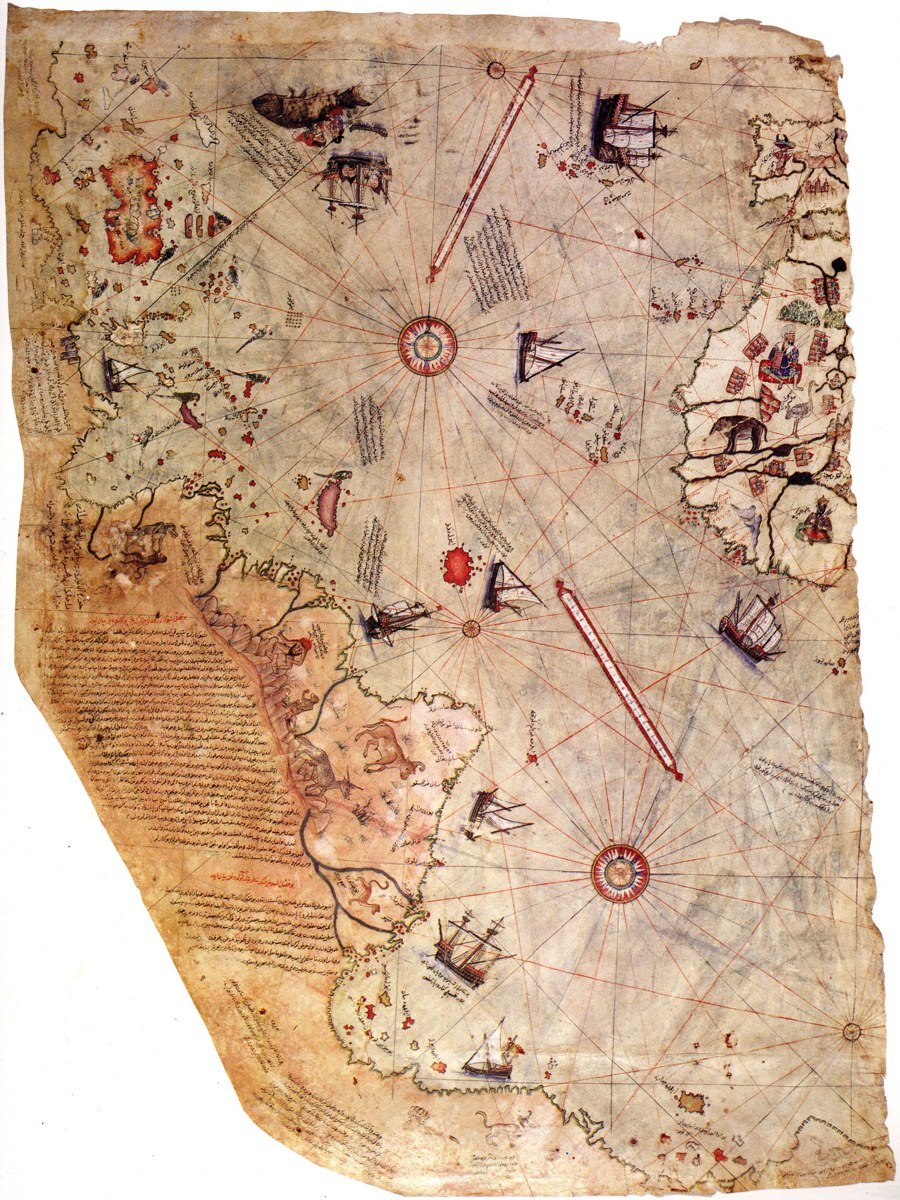
1 · Piri Reis's world map — the surviving fragment, 1513.
Maker: Piri Reis, Ottoman admiral and cartographer · Date: 1513; presented to Sultan Selim I in 1517 · Holding source: Topkapı Palace Museum, Istanbul (No. H 1824), via Wikimedia Commons — public domain, verified on the file page, 2026-10-28.
What it shows: Ottoman knowledge of the world at the height of the empire's expansion — the Atlantic drawn from some twenty sources the maker names on the map itself, among them Portuguese charts and a map Piri Reis says Columbus drew: the Mediterranean world, the African coast, and across the ocean the Caribbean and the South American coast, in Ottoman hands within a generation of 1492. The empire this class teaches was a mapmaking, sea-going state, and this is its own document.
What it does not show: the whole of Piri Reis's map — only the western fragment survives, rediscovered in the Topkapı library in 1929; the eastern part is lost. It does not show an Ottoman America, or any Ottoman voyage to it: the American coasts here are compiled from captured and purchased European charts, which is exactly what the map's own notes say.
A period document: borders and names are its maker's, not today's. The strand's maps are taught whole in The Mapping of the World class, cross-linked in this page's reading list, and are not duplicated here.
2.3 How the empire was run — and how it was built
DOCUMENTED. The machine had three great parts, all of them visible in the registers. The timar system paid the provincial cavalry, the sipahis, not in cash but in assigned land revenues — a village's taxes, surveyed in the tahrir and granted in return for mounted service, revocable and re-surveyed as the state required. The palace service drew its men by a levy this class states plainly: the devshirme, a periodic taking of Christian boys from the Balkan villages, carried to the capital, converted to Islam, and educated — the most able in the palace school, the Enderun, from which grand viziers rose; the rest trained as Janissaries, the sultan's salaried musketeer infantry, forbidden at first to marry or trade, a corps loyal to the sultan alone because it had no other patron. The record holds both faces of the levy and the class prints both: it was resisted and evaded by families who hid or maimed their sons to save them, and in parts of Bosnia it was also sought after, parents bribing the recruiting officers to take a boy into the one career that could carry a village child to the grand vizierate. It was, in either face, a taking of children by the state, and it wound down across the seventeenth century as the corps became hereditary in practice. The third part was law and locality: the sultan's kanun beside the sharia courts of the kadis in every district town, and the empire's religious communities — Greek Orthodox, Armenian, Jewish and the rest — worshipping and judging their personal law under their own recognised heads, the arrangement later systematised under the name “millet system”; how formal and uniform that system really was before the nineteenth century is DEBATED among Ottoman historians, and the class files the neat version as the later tidying it partly is.
DOCUMENTED — the built empire. What the registers paid for still stands. The architect Sinan — himself a devshirme recruit, carried from a Christian village to the chief royal architect's office he held for fifty years (1538–1588) — built the empire its skyline: the Süleymaniye complex in Istanbul (1550–57), mosque, schools, hospital, soup kitchen and the Lawgiver's tomb on one hill; and the Selimiye at Edirne (1568–75), the dome he himself recorded as his masterpiece. Around the buildings ran the waqf system — pious endowments whose rents maintained mosques, schools, baths, caravanserais and public kitchens in every Ottoman city, a welfare architecture written into property law. Iznik's tiles, the court calligraphers and miniaturists, the coffee houses Evliya describes — the empire at its height was not a camp but a civilisation with a paperwork memory, and its traveller's ten volumes are the proof a student can hold.
2.4 The turn — and the argument about “decline”
DOCUMENTED. The turn came in stages, and the class dates them rather than narrating a fall. At Lepanto in 1571 a Holy League fleet destroyed the Ottoman battle fleet — and the state rebuilt a fleet within a year and kept Cyprus, which the war had been fought over; both halves stand in the record and both are printed. The Long War with Austria (1593–1606) ended at Zsitvatorok in parity, the sultan treating the emperor as an equal for the first time. The Celali revolts shook Anatolia around 1596–1610 — tax, climate pressure and demobilised soldiers together — and Koçi Bey, writing in 1631, told his sultan to his face what had rotted: offices sold, timars given to courtiers instead of cavalry, the Janissary rolls swollen with tradesmen. From 1656 the Köprülü grand viziers restored the centre's grip by severity. Then the last great advance: Crete finished (1669), and in 1683 the second siege of Vienna, which failed. The Holy League war that followed ran sixteen years and ended at Karlowitz in 1699 with the first great Ottoman cessions in Europe — Hungary and Transylvania to Austria, the Morea to Venice, Podolia to Poland. DEBATED, and the class's last word on the subject: the older story of a straight “decline” from Süleyman's death to the empire's end is no longer held by most Ottoman historians, who read the same centuries as adaptation — a fiscal, military and provincial order changing under pressure, sometimes badly, sometimes inventively, for two further hundred years of life. Koçi Bey proves that Ottomans themselves were arguing about corruption and reform in 1631. An empire arguing about its own reform in its own memoranda is not an empire in a fable of decay; it is a state, ageing as states do, in documents its students can still read.
§3 — THE SAFAVIDS: IRAN MADE SHI'A, ISFAHAN MADE BEAUTIFUL
3.1 The voices that lead
DOCUMENTED — the section's sources. The Safavid section is led by the empire's own court history: Iskandar Beg Munshi's ʿĀlam-ārā-yi ʿAbbāsī — the World-Adorning History of Abbas — written by Shah Abbas's own secretary and munshi, the fullest Persian account of the reign that made the empire classical. Behind it stands the Safavid chronicle tradition, and beside the chronicles stand the made things this class reads as documents: the Shahnameh of Shah Tahmasp, the great illustrated Book of Kings produced in the royal atelier (c. 1525–35), among the supreme manuscripts of Islamic art; and the city of Isfahan itself, whose maydan, mosques and bridges are Abbas's policy in stone and tile.
3.2 A Sufi order takes a throne, 1501–1555
DOCUMENTED. The Safavids began not as a dynasty but as a Sufi order at Ardabil, in the mountains of Azerbaijan, whose devotees among the Turkmen tribes — the Qizilbash, “red heads,” for the twelve-gored red cap of their allegiance to the Twelve Imams — held the order's master to be something close to divine. In 1501 their fourteen-year-old master, Ismail I, took Tabriz and was crowned shah, and proclaimed Twelver Shi'a Islam the religion of the state — in a land whose people were then mostly Sunni. Over the following century Iran became Shi'a, and the fact still draws the region's map: but the class states how it happened, plainly, because the record does. It was state-driven, and at its edges coercive — Sunni scholars killed or driven into exile, Sunni orders and shrines suppressed, public ritual cursing of the first caliphs enforced, Arab Shi'a scholars imported from Lebanon and Bahrain to staff a clergy Iran did not yet have. The Ottomans answered in kind against Qizilbash sympathisers in Anatolia, and the two empires' long wars were fought partly as a war of religions. In 1514, at Chaldiran, the lesson of the age was taught in blood: Selim I's musketeers and artillery, chained in a wagon line, shot the Qizilbash cavalry charge to pieces — the Safavids, who had despised firearms as unchivalrous, spent the next century acquiring guns, gunners and infantry. Ismail never recovered his aura; his son Tahmasp I (1524–1576) held the state together through fifty years of Ottoman and Uzbek war, and the Peace of Amasya (1555) fixed the western frontier — the first formal Ottoman–Safavid settlement.
3.3 Abbas the Great and Isfahan, 1587–1639
DOCUMENTED, from Iskandar Beg's history. Shah Abbas I (r. 1587/88–1629) rebuilt the empire his inheritance had nearly lost. He broke the Qizilbash emirs' over-might with a new standing army — musketeers, artillery, and a corps of ghulams, Georgian, Circassian and Armenian converts loyal to the shah as the devshirme men were to the sultan — and with it recovered province by province what Ottomans and Uzbeks had taken. He made silk a crown monopoly, Iran's cash crop sold to Europe, and in 1598 he moved his capital inland to Isfahan and rebuilt it as the empire's showpiece: the great maydan, a polo ground and parade square longer than any in Europe, with the Shah Mosque's blue dome at its head, the small perfect mosque of Shaykh Lutfallah across it, the Ali Qapu palace overlooking it, and the bazaar's vaulted miles behind — a capital the Persian saying called half the world. And the class prints, in the same paragraph as the beauty and in the same size of type, the cost that paid part of it: retreating before an Ottoman advance in 1604–05, Abbas practised scorched earth in the Caucasus borderlands and deported the Armenians of Julfa — a whole merchant city marched south, many dying on the road, the survivors set down across the river from Isfahan in a suburb built for them, New Julfa, whose churches they raised and whose merchant houses ran the shah's silk to Amsterdam and Manila. The deportation's suffering and the suburb's prosperity are both in the record; neither is permitted to erase the other. With English ships' help Abbas retook the island of Hormuz from the Portuguese in 1622, ending a century of Portuguese command of the Gulf's mouth; and the Treaty of Zuhab (1639), after his death, fixed the Ottoman frontier along lines that, in the Zagros, largely endure to this day.
3.4 The end comes from inside, 1642–1736
DOCUMENTED. Abbas II (1642–1666) held his grandfather's state — Kandahar retaken, the court at Isfahan still brilliant for Evliya's and the European travellers' describing. Then the line thinned: sultans raised in the harem's seclusion rather than in provincial governorships, faction at court, the treasury thinner, the Afghan frontier neglected. Under the pious and incapable Sultan Husayn, the Ghilzai Afghans of Kandahar, revolted under Mir Mahmud Hotak, marched across the desert in 1722 and shut Isfahan up to siege. The contemporary record of the siege is a famine record — a great city starving street by street while relief armies dissolved — and in October 1722 the shah surrendered his crown to Mahmud in person. Safavid princes and pretenders flickered on until 1736, when the empire's own Persian general, Nader, took the throne for himself. The class ends the section where the record ends it: the Safavid empire was not taken by the dockside states of the companion class, whose ships it had fought and traded with for two centuries. It fell from inside the Iranian world — to hunger, faction and an Afghan army from its own frontier.
§4 — THE MUGHALS: THE FOUNDER'S OWN PEN
4.1 The voices that lead
DOCUMENTED — the section's sources. No empire of the three is so lucky in its first voice. The Baburnama is the founder's own memoir, written by Babur in his mother tongue, Chagatai Turkic — a conqueror who writes about strawberries, melons, betrayal, hangovers, the exact look of Hindustan's rain and his homesickness for Kabul's gardens, and who judges the country he has just conquered with a merchant's eye and a poet's temper. For his great-grandson's empire the voice is Abu'l Fazl's: the Akbarnama, the official history of Akbar, and its third volume the Āʾīn-i Akbarī (c. 1598), a gazetteer of the whole empire — every department, rank, price, tax rate and province described by the minister who ran it, the single richest administrative document any of the three empires left. Jahangir resumed the founder's habit and wrote his own memoir, the Tuzuk-i Jahangiri; Shah Jahan's reign is carried by the Padshahnama court histories and by his buildings.
4.2 Babur and the gunpowder case, 1526–1556
DOCUMENTED. Zahir-ud-din Muhammad Babur — a Timurid prince of Ferghana, descendant of Timur on one side and of Chinggis Khan on the other (the name “Mughal” is the Persian for Mongol) — lost his own Central Asian kingdom, took Kabul, and turned south. On 21 April 1526, on the plain of Panipat, his small army — Babur gives his fighting strength in the low tens of thousands against a Delhi host many times larger — destroyed the army of Ibrahim Lodi, the last Delhi sultan, in a morning. The Baburnama itself explains how, and it is this class's best single exhibit for its title: field guns and matchlockmen firing from behind a laager of carts roped together in the Ottoman manner, a gunner from the Ottoman world, Ustad Ali Quli, commanding the artillery, and Babur's cavalry wheeling round both flanks in the steppe's own tulughma manoeuvre. Gunpowder won Panipat — in harness with steppe horsemanship, on a field chosen by a memoirist who tells you so. Babur died in 1530; his son Humayun lost the whole conquest to the Afghan Sher Shah Suri, wandered into Persian exile, and won it back in 1555, a year before his death — leaving the empire, the second time, to a thirteen-year-old.
4.3 Akbar's machine, 1556–1605 — from the Āʾīn
DOCUMENTED, from Abu'l Fazl's own tables. Akbar (1556–1605) is the empire's architect, and the Āʾīn-i Akbarī is his blueprint, written by his minister while it ran. Its two great systems governed everything. The mansabdari: every imperial officer held a mansab, a numbered rank fixing the cavalry he must maintain and the salary he drew — paid usually not in cash but in a jagir, the assigned tax revenue of specified lands, revocable, transferable and never hereditary, so that the empire's whole nobility, Turani, Irani, Indian Muslim and Rajput Hindu together, served at the emperor's pleasure and ate from his hand. The zabt revenue settlement, perfected under the finance minister Todar Mal: land measured with a standard rod, soils classified, yields averaged over ten years, the state's share — about a third — fixed in cash rates, village by village, in registers that survive. Around the machine stood a policy Abu'l Fazl names: sulh-i kul, peace with all. Akbar abolished the jizya, the tax on non-Muslims (1564), and the pilgrimage tax; he married Rajput princesses and raised Rajput rajas to his highest commands; his armies took Gujarat, Bengal and Kashmir, and his court at Fatehpur Sikri — the red sandstone city he built and then left — hosted the famous debates among Muslim, Hindu, Jain, Parsi and Jesuit speakers. The small devotional circle around his person, the so-called Din-i Ilahi, is DEBATED in the scholarship — a new religion, a court discipleship, or a minister's panegyric enlarged by enemies — and the class carries the debate without settling it. What is not debated is the weight of the thing Akbar built: on Abu'l Fazl's own figures an empire of perhaps a hundred million people, taxed, ranked and registered; and an economy whose cotton textiles clothed much of the world and pulled the world's silver steadily eastward in payment — the flow whose other end stands in the Theft of Resources class.
4.4 The marble century and the long Deccan war, 1605–1707
DOCUMENTED. Jahangir (1605–1627) kept the machine and indulged the atelier: Mughal miniature painting reached its peak of observation in his court — Ustad Mansur's studies of birds and animals, painted from the life at the emperor's order — and his memoir records, in the same unembarrassed voice, his chain of justice for petitioners, his opium and wine, and his empress Nur Jahan's rise to a power the coinage itself acknowledged. Shah Jahan (1628–1658) rebuilt the empire's face in white marble: the Red Fort and the great mosque at his new Delhi, and at Agra the Taj Mahal — raised after the death of his wife Mumtaz Mahal in 1631, begun 1632, its complex substantially complete by 1653, its chief architect named in the court record as Ustad Ahmad Lahori, its twenty thousand workmen drawn from across the empire and beyond. A photograph of the Taj from Samuel Bourne's Indian tour of the 1860s was intended for this page; its file page could not be verified in this pass, so under this site's image law the picture is owed, not placed, and the building is taught here from the court record — which is, in any case, where this class teaches everything from. Shah Jahan's sons fought the empire's most savage succession war over his sickbed in 1657–59; the victor, Aurangzeb (1658–1707), imprisoned his father in Agra Fort — in sight of the Taj — and ruled for forty-nine years. His reign took the empire to its greatest extent: the Deccan sultanates of Bijapur (1686) and Golconda (1687) annexed, the frontier carried almost to the subcontinent's tip. He reimposed the jizya in 1679, which Akbar had abolished. And he spent his last twenty-five years in the Deccan, in person, chasing the Maratha power Shivaji had founded — taking its forts one by one and never finishing it. DEBATED, at the class's weight: how far Aurangzeb's religious policy broke his great-grandfather's settlement (temple destructions are documented in particular cases; so are his protective orders and grants to other temples, and Hindu officers remained a large share of his mansabdars); how far the “jagirdari crisis” — more ranked officers than revenue assignments to pay them — was already strangling the machine; and whether decline begins in his reign or only in the succession wars after his death in 1707. The class prints the debates as debates. What followed is not debated: emperor after emperor made and unmade by court factions, the provinces peeling into successor states, the Marathas riding to Delhi — and in 1739 Nader Shah, Persia's new conqueror from the Safavids' ashes, sacking Delhi and carrying off the Peacock Throne and the accumulated treasure of two centuries. The three empires of this class end, as they began, in one another's hands. Eighteen years later, at Plassey (1757), the English East India Company — the chartered instrument of the companion class — turned trade into territory in Bengal, and the story passes to the classes named below.
§5 — THREE EMPIRES, ONE CENTURY-SPAN: THE CLOSE
DOCUMENTED — the comparison the record supports. Set the three side by side at 1650, the middle of their span, and the comparison this volume exists to make comes into focus. Europe in 1650 was a patchwork of confessionally armed states that had just spent thirty years killing perhaps a fifth of the Empire's people over theology and dynasty. The three empires of this class, in the same year, governed — through registers, ranks, endowments and roads — from the Danube to the Bay of Bengal: the Ottomans in what Koçi Bey shows us as argumentative working order; the Safavids in Abbas II's Isfahan; the Mughals in Shah Jahan's Delhi, the richest court on earth on the testimony of every traveller who saw it, European travellers included. Each of the three ran a system for ruling many peoples and religions from one centre — the timar and the levy, the ghulam corps and the silk monopoly, the mansab and the zabt — and each left the paperwork to prove it, in its own language, which is why this class could be written from their records first. Their declines, when they came, came chiefly from inside and from each other — Afghan, Persian and Maratha hands, succession wars, fiscal strain — and only late and at the edges from the dockside states of Europe, whose companies enter this volume's Asian story as licensed guests at Canton, Dejima, Surat and Hormuz long before they enter it as rulers. That is the proportion the other shore restores: for most of 1500–1800, the ships were sailing to power, not from the only power there was.
Sources
The empires' own records, as named in the text: Aşıkpaşazade, Chronicle (15th c.) · the Ottoman tahrir registers and kanunnames · Piri Reis, world map (1513) and Kitab-ı Bahriye (1521/1526) · Evliya Çelebi, Seyahatname (journeys from 1640) · Koçi Bey, Risale (1631) · Iskandar Beg Munshi, ʿĀlam-ārā-yi ʿAbbāsī (history of Shah Abbas) · the Shahnameh of Shah Tahmasp (c. 1525–35) · Babur, Baburnama · Abu'l Fazl, Akbarnama and Āʾīn-i Akbarī (c. 1598) · Jahangir, Tuzuk-i Jahangiri · the Padshahnama histories of Shah Jahan's reign.
Modern works named in the text: Marshall G. S. Hodgson, The Venture of Islam (1974), and William H. McNeill, for the coinage of “gunpowder empires” · the modern Ottoman scholarship rejecting the simple decline thesis, and the modern Mughal scholarship of the jagirdari-crisis and Aurangzeb debates, as carried in the sections.
Read beside this class: The Slave Trades · The Theft of Natural Resources · The Other Shore — Europe Remade · Ming and Qing China and Tokugawa Japan · The Genocide Record · The Mapping of the World · The Chronology — The Whole History in Order of Time.
Record: THE_OTHER_SHORE_RESEARCH_2026-10-28.md (study_materials/world_history), Part B and Part D — this class rests on that research file, whose debated points (the gunpowder label itself, the formality of the millet system, the Ottoman decline thesis, the nature of Akbar's Din-i Ilahi, and the causes and dating of Mughal decline) are carried openly in the reading itself. The Taj Mahal photograph owed for §4 is logged in that file's image register.