The History of the World · Grades 10–13 · College · University
The Other Shore — Europe Remade, 1500–1800
History · Level band: Grades 10–13 · College · University
English edition — the language editions of the history classes are outstanding and will follow the site’s translation pattern; none is fabricated here.
§1 — WHY THIS SHORE HAD NO CLASS, AND WHY IT NEEDS ONE
DOCUMENTED — the audit that commissions this class. This site's completeness audit of 28 October 2026 found the early-modern centuries covered on one shore and missing on the other. The conquest shore is deep: the Chronology's Eras 3 and 4 hold 137 dated entries, and the Genocide Record class carries what was done in the Americas and the world from 1492 forward, document by document. The shore those ships sailed from — the Europe of print, of the Reformation, of the new astronomy, of the treasuries and chartered companies that fitted out the fleets — had no class at all. A reader could walk the whole record of what the ships did and never be taught what made the ships. This class, and its two companions — the gunpowder empires of Asia, and Ming–Qing China with Tokugawa Japan — are that missing shore. How to read this class: DOCUMENTED = the fact stands in a named source, a document, register or scholarly record the research file names. DEBATED = the sources dispute it, and the dispute is printed. CLAIM = a claim carried at its weight, including legends the record does not hold. The documents speak first in every section; where a section rests on a famous book, the book itself is the evidence.
§2 — PRINT: THE MACHINE THAT REMADE THE SHORE
DOCUMENTED, with the priority stated whole. Printing was not invented in Europe. Chinese woodblock printing is centuries older than Gutenberg; movable type was made in China in the eleventh century, and metal movable type was printing books in Korea by 1377, when the Jikji was printed. What Johannes Gutenberg built at Mainz around the 1440s–1450s was a system: type cast in a hand mould so letters could be made by the thousand and used again, oil-based ink that would stick to metal, a screw press adapted to paper, and paper cheap enough to feed it. The system's monument is his 42-line Bible of about 1455 — a printed book made to stand beside the great manuscript Bibles, and indistinguishable in ambition from them. What the system changed was not the book. It was the number of books, and with the number, everything downstream.
DOCUMENTED, the figures carried as the sources give them. When Mainz was sacked in 1462 its printers scattered, carrying the craft with them. By 1500 presses stood in roughly 240 to 280 European towns — the count differs by how a town with a press is counted, and the class carries the range. The British Library's Incunabula Short Title Catalogue lists over 30,000 distinct editions printed before 1501. Estimates of total output by 1500 run from about eight million to twenty million copies, for a European population of perhaps seventy million; over the following century output rose roughly tenfold. Venice, with some 150 presses by about 1500 on the usual count, became the trade's capital — a Venetian scribe was already complaining within a few years of the press's arrival that the city was stuffed with books. Print runs before Gutenberg were counted in dozens, copied by hand over months. After him, an edition was counted in hundreds, and a text, once printed, could not be unpublished.
DOCUMENTED — what print did first. Print's first mass political use was religious, and it ran in both directions at once. The indulgence trade that provoked Luther was itself a print business — printed indulgence forms with blanks for the buyer's name came off presses by the thousand. Luther answered in kind: his pamphlets, sermons and Bible translations made him the first author of the print age, his works forming a large share of German-language print in the 1520s (the exact share is estimated differently by study and is carried here without a figure). The Catholic answer also ran on print: the Index of Prohibited Books, first issued in 1559 and revised under the Council of Trent in 1564, is a printed list meant to govern printed books — censorship as a print technology. And print built the state's nervous system: a printed newspaper appears at Strasbourg in 1605, and by 1700 gazettes, price currents and shipping news were routine. The dockside states of §6 ran on paper — licences, charts, manifests, shares, gazettes. Print is the first cause of this class because it is the medium every other cause travelled in.
§3 — THE REFORMATION: THE DOCUMENTS THEMSELVES
DOCUMENTED — the theses, at their face. On 31 October 1517 Martin Luther, an Augustinian friar and professor at Wittenberg, sent his archbishop a Latin academic disputation: the Disputation on the Power and Efficacy of Indulgences, the 95 Theses. Its target was a trade: indulgences — remissions of penance, sold to the living and, in the preaching of the day, applied to the dead in purgatory — were being marketed in the German lands to finance the rebuilding of St Peter's in Rome and to repay the banking house of Fugger for the loan that had bought Albert of Mainz his archbishopric. The theses are a scholar's challenge to debate that trade's theology, and they begin inside it — the first thesis is about repentance, not rebellion. Whether Luther also nailed them to the Wittenberg church door is DEBATED: the posting rests on Melanchthon's account written after Luther's death; the sending, and the date, are documented. Print made the difference between a disputation and a detonation: translated, reprinted and spread within weeks, the theses were read across Germany before Wittenberg's own authorities had finished reacting.
DOCUMENTED — the break. The argument widened from indulgences to the authority that sold them. In 1520 the papal bull Exsurge Domine condemned Luther's propositions; Luther burned the bull publicly at Wittenberg, with the canon law beside it. Summoned before the Emperor Charles V at the Diet of Worms in 1521 and ordered to recant his books, he refused; the Edict of Worms outlawed him, and the Elector of Saxony hid him in the Wartburg, where he translated the New Testament into German — printed in 1522, the full Bible in 1534. The Reformation's confessions then wrote themselves down as documents, and the class names them as documents: the Augsburg Confession of 1530, Melanchthon's measured statement of the Lutheran position, presented to the Emperor; Calvin's Institutes of the Christian Religion (first edition 1536), the Reformed system's architecture, and Geneva from 1541 as its working city; the Council of Trent (1545–1563), the Catholic reform defining itself against the Protestants — scripture and tradition, seven sacraments — while reforming the sale of offices and the training of priests at the same time. England's break came by statute before it came by theology: the Act of Supremacy of 1534 made the king, not the pope, head of the English church.
DOCUMENTED — the settlement, and a formula flagged. After a generation of pressure and one short war, the Peace of Augsburg (1555) settled the Empire's religion by territory: each prince could establish Catholicism or the Augsburg Confession in his lands; a subject who dissented could emigrate. The Reformed were not included; Anabaptists were not included. The settlement's famous summary, cuius regio, eius religio — “whose realm, his religion” — is not the treaty's wording: it is a jurists' formula from around 1600 that later textbooks put in the treaty's mouth. The class prints the distinction because it is the shape of this whole shore: the age's real documents are usually narrower, colder and more legal than the slogans that remember them.
DOCUMENTED — the radical edge, stated plainly. The Reformation's language escaped its authors. In the German Peasants' War of 1524–25, peasants framed their demands — against serfdom, tithes and lordly exactions — in the gospel's terms, and Luther, whose words they carried, condemned them in print and urged the princes to strike. The war was put down with great killing; the dead are estimated in the tens of thousands, the sources differing, carried here as a range and not a count. Anabaptists — who baptised adults, refused oaths and the sword, and were therefore a threat to every magistrate — were persecuted and executed by Catholic and Protestant authorities alike; the Anabaptist kingdom seized at Münster in 1534–35 ended in siege, starvation and the public execution of its leaders. The wars of religion began, that is, inside the households of the reform as well as between the confessions, and this class does not smooth that.
§4 — THE WARS OF RELIGION
DOCUMENTED — France. France fought eight civil wars between 1562 and 1598 between the Catholic crown and its parties and the Protestant Huguenots. Their centre of horror is dated: on St Bartholomew's Day, 24 August 1572, with the Huguenot leadership gathered in Paris for a royal marriage, royal troops and Catholic crowds killed them in the city, and the killing spread to the provinces over the following weeks. Modern estimates run to about 2,000–3,000 dead in Paris and several thousand more in the provinces; contemporary figures run far higher and are not carried here as counts. The wars ended in exhaustion and a converted king: Henry IV, a former Huguenot on the throne, issued the Edict of Nantes in 1598 — freedom of conscience for Huguenots, public worship in named places, fortified towns held as security. It held for eighty-seven years. In 1685 Louis XIV revoked it by the Edict of Fontainebleau, forbade Protestant worship, and drove a large exodus — commonly estimated at 150,000 to 200,000 people, carried as an estimate — into England, the Netherlands, Brandenburg and beyond, taking their skills in cloth, paper, glass and finance with them. Toleration and its revocation are both documents; the class teaches both.
DOCUMENTED — the Empire's thirty years. The Thirty Years' War began in Bohemia in 1618, when Protestant nobles threw two imperial regents from a window of Prague Castle and the revolt spread; it widened stage by stage — Danish, then Swedish, then French intervention — until Catholic France was fighting on the Protestant side against the Habsburg Emperor and Spain. That fact stands in the class as the war's own commentary: confession and dynasty ran in the same harness, and whether the war was “religious” or “political” is DEBATED as a question, with the working consensus of the scholarship that it was both at once. Its cost was paid mostly off the battlefield. On Peter H. Wilson's estimate, the Empire lost perhaps a fifth of its population in the war years, most of them to disease and hunger in the armies' paths; older estimates run higher, and the class carries the range rather than a single figure. Districts the armies crossed twice were, in the phrase of the time, eaten bare.
DOCUMENTED — Westphalia, without the textbook gloss. The Peace of Westphalia of 1648 — treaties signed at Münster and Osnabrück after years of congress — ended the war in the Empire. Its documents extended the Augsburg settlement to the Reformed, fixed the year 1624 as the normative year for the possession of church property, and confirmed the princes' territorial authority. Pope Innocent X condemned the treaties as null and void; the powers ignored him, which is itself a measure of the shore Europe had reached. Textbooks often call Westphalia the birthday of the modern state system and of sovereignty itself; that reading is a later interpretation and is carried in this class as a CLAIM about the treaties, not as their text. What the text did was narrower and harder: it wrote confessional coexistence into imperial law because the alternative had been tried for thirty years.
§5 — THE SCIENTIFIC REVOLUTION: A SHELF OF DOCUMENTS
This section is built as the commission requires — the revolution at the primary record, its own documents first, in the order they appeared. Each book is read at its face, including its hedges, its patrons and its punishments.
5.1 The double year, 1543
DOCUMENTED. In 1543, at Nuremberg, Nicolaus Copernicus's De revolutionibus orbium coelestium — On the Revolutions of the Heavenly Spheres — printed the heliocentric order whole: the Sun near the centre, the Earth a planet among planets, turning daily and circling yearly, the Moon circling the Earth. Copernicus, a cathedral canon at Frombork, had circulated a short sketch decades earlier and held the great book back for years; it reached print in the year of his death. And it reached print wearing a hedge he did not write: the book opens with an anonymous preface telling the reader that the hypotheses in it need not be true, nor even probable — they need only yield calculations that agree with observation. The preface was written by Andreas Osiander, the Nuremberg theologian who saw the book through the press; Kepler identified him as its author in 1609. The class prints the hedge because the hedge is the document: the most consequential book of the century entered the world officially pretending to be a calculating device. The same year, at Basel, Andreas Vesalius published De humani corporis fabrica, anatomy rebuilt on the dissection of human bodies, its plates drawn from what the knife actually found — the second 1543 book, and the same method pointed at the body instead of the sky: look, and print what you see.
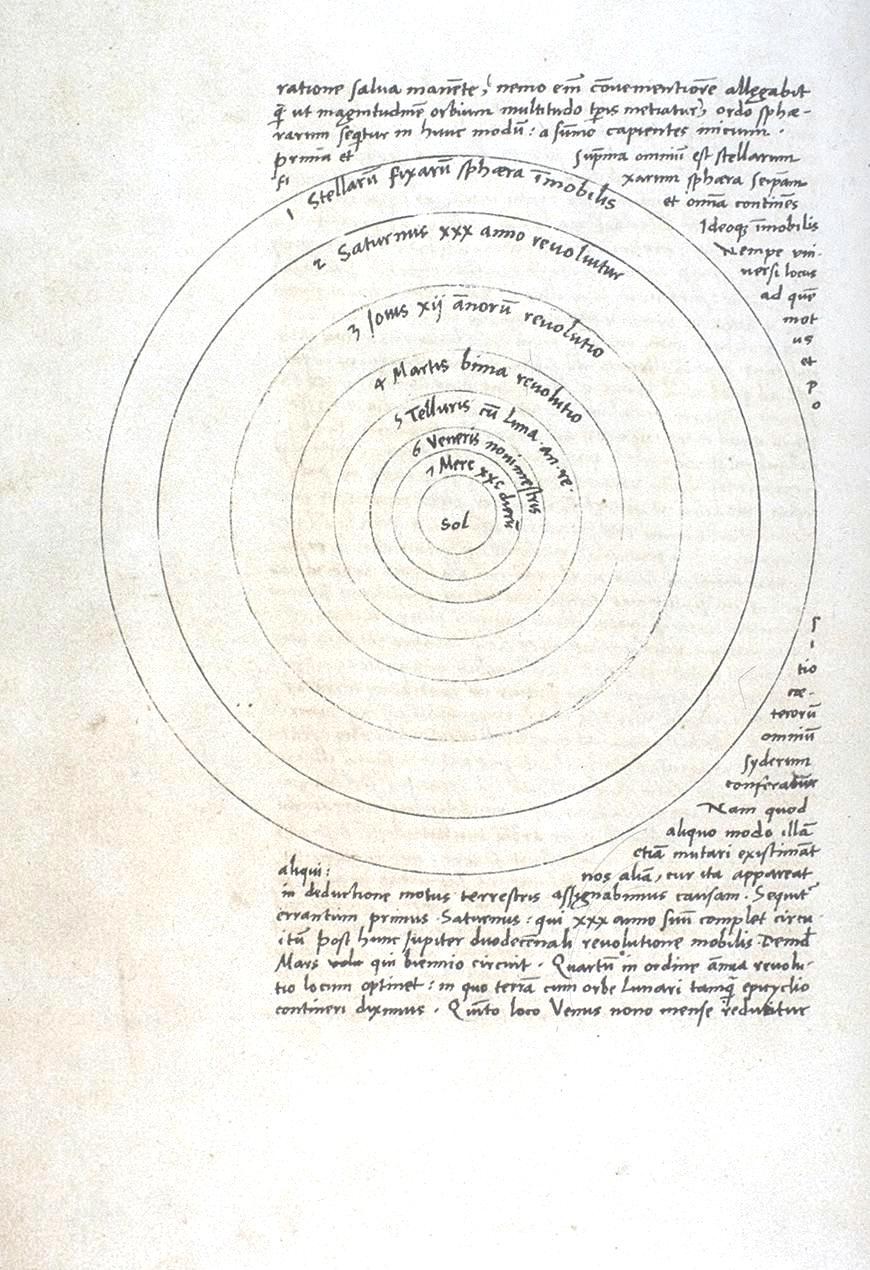
1 · Copernicus's own diagram of the order of the spheres.
Maker: Nicolaus Copernicus, autograph manuscript of De revolutionibus, Book I, chapter 10 (“The Order of the Heavenly Spheres”) · Date: manuscript c. 1520–1541; the work printed at Nuremberg, 1543 · Holding source: Jagiellonian Library, Kraków (accession 10 000), via Wikimedia Commons — public domain, verified on the file page, 2026-10-28.
What it shows: the revolution in the author's own hand — concentric circles with the word Sol, the Sun, at the centre, and the spheres lettered outward in Latin: Mercury's revolution in 80 days, Venus in nine months, “the Earth, with the Moon, an annual revolution,” Mars in two years, Jupiter in twelve, Saturn in thirty, and outermost the immovable sphere of the fixed stars. The order of the planets by their periods is the argument, drawn.
What it does not show: ellipses, or any telescope observation — Copernicus kept perfect circles and worked from the inherited observations; the proving of the system took the next century and a half, and is the rest of this section.
A period document: its astronomy is its maker's, as he left it in manuscript, not the printed book's tidied plate.
5.2 The evidence arrives, 1609–1610
DOCUMENTED. Johannes Kepler, working from the observation books of Tycho Brahe — the Danish nobleman whose island observatory at Uraniborg had gathered the most accurate naked-eye measurements ever made — published the Astronomia Nova in 1609: Mars does not move in a circle. Its orbit is an ellipse with the Sun at one focus, and the line from Sun to planet sweeps equal areas in equal times. Two of Kepler's three laws stand in that book (the third followed in 1619), won by years of calculation he shows his working for, dead ends included. The next year Galileo Galilei turned a Dutch invention, the telescope, to the sky and printed what he saw within months: the Sidereus Nuncius, the Starry Messenger, Venice, 1610. Mountains and craters on the Moon — so the heavens are not perfect, unchanging crystal. Four small stars attending Jupiter, changing sides night by night — moons of Jupiter, so not everything in heaven circles the Earth. The Milky Way resolved into stars beyond counting. His letters added the phases of Venus, which the Ptolemaic order cannot produce and the Copernican order requires. The documents of 1609–10 are the moment the argument stopped being about elegance and became about evidence that any reader with a tube and lenses could check.
5.3 Programme and proof, 1620–1628
DOCUMENTED. Francis Bacon's Novum Organum (1620) supplied the programme — knowledge built upward from ordered experiment and observation, against the idols of received opinion — a manifesto whose author performed few experiments himself, carried in the class as a programme and not as a result. William Harvey's De motu cordis (1628) supplied a result, and proved it by arithmetic: measure the heart's output, and in an hour it moves more blood than the whole body weighs — more than food could make or the tissues consume. Therefore the blood is not continuously made and used up, as the old physiology held; it goes round, in a circuit, out by the arteries and back by the veins. One measured quantity, honestly followed, dissolved thirteen centuries of Galenic medicine. The class sets Bacon and Harvey side by side deliberately: the age needed both the trumpet and the proof.
5.4 The trial, 1632–1633
DOCUMENTED — the sentence at its own terms. Galileo's Dialogue Concerning the Two Chief World Systems was printed at Florence in 1632, licensed, cast as a discussion among three speakers in which the Copernican speaker wins the arguments and the defender of the old system is named Simplicio. Within the year the book was suspended and Galileo summoned to Rome. On 22 June 1633 the Roman Inquisition pronounced him “vehemently suspect of heresy” — its own graded term, printed here as it stands — for holding that the Sun stands still at the centre and the Earth moves, contrary to Scripture as the Church then read it. He abjured on his knees, the Dialogue went on the Index of Prohibited Books, and he lived his remaining nine years under house arrest at Arcetri — where he wrote his last and most durable book, on motion, smuggled out and printed in Protestant Leiden in 1638. The sentence “Eppur si muove” — “and yet it moves” — which Galileo is said to have muttered on rising, is CLAIM, carried as legend: it is not in the trial record and is first attested long after his death. The record needs no mutter. A seventy-year-old man was made to kneel and deny what his telescope had shown him, and the book he wrote under arrest founded the science of mechanics; both halves are the document.
5.5 Synthesis and institution, 1637–1687
DOCUMENTED. René Descartes's Discours de la méthode (1637) gave the age its method in the vernacular and its starting rule — accept nothing as true that is not presented clearly and distinctly — with a mechanical universe of matter and motion built on it. The revolution then acquired institutions, which is why it did not die with its makers: the Royal Society of London, founded 1660 and chartered 1662, took as its motto Nullius in verba — on no one's word — and its Philosophical Transactions (from 1665) made experiment a published, checkable, cumulative record; the Paris Academy of Sciences followed in 1666. The shelf closes at Cambridge in 1687: Isaac Newton's Philosophiae Naturalis Principia Mathematica, the Mathematical Principles of Natural Philosophy, deriving Kepler's three laws from a single law of universal gravitation — every body attracting every other by the inverse square of the distance — so that the fall of an apple and the circuit of the Moon stand in one mathematics. In the General Scholium added in 1713 Newton stated the method the whole shelf had been learning: hypotheses non fingo, I feign no hypotheses — what is not deduced from the phenomena is not to be admitted. DEBATED, and printed: “the Scientific Revolution” as one event with a birthday in 1543 is a historians' construction (the phrase was popularised by Herbert Butterfield in 1949); medieval scholars had prepared parts of the ground, and parts of Copernicus's mathematics repeat devices worked out earlier in the astronomy of the Islamic world — the Maragha school and Ibn al-Shāṭir — the resemblance being documented and the route of transmission debated. The shelf is real; its label is modern. Both are taught.
§6 — THE STATES THAT BUILT THE SHIPS
DOCUMENTED — the first dockside machines. The ships did not sail from harbours in general; they sailed from states built to send them. Portugal ran its India trade as a crown enterprise from Lisbon. Spain built the tighter machine: the Casa de Contratación, the House of Trade at Seville, founded 1503, which licensed every ship, pilot and cargo for the Americas, examined and licensed the pilots, kept the master chart — the Padrón Real — from which all sailing charts derived, taxed the trade, and funnelled a hemisphere's commerce through one river port under the crown's hand. The silver fleets, the convoy system, the councils in Madrid that governed by paper across an ocean — this was the first shore's administrative invention, and its other face, the registered wealth it drew out of the Americas, stands in the Theft of Resources class, cross-linked below.
DOCUMENTED — the chartered company. The second invention shared the risk the crown would not carry alone. England chartered its East India Company on 31 December 1600. The Dutch went further in 1602: the States General forced the competing pre-companies into one Vereenigde Oostindische Compagnie, the VOC, with a monopoly of Dutch trade east of the Cape of Good Hope, capital locked in permanently, shares that any resident could buy and — the new thing — sell to another buyer, priced in a market that within the decade had its own exchange building at Amsterdam (1611). The Bank of Amsterdam (1609) steadied the money those prices were struck in. And the charter gave the company sovereign powers in its zone: to build forts, keep armies and navies, sign treaties and make war. A company that could wage war, governed by merchants, owned by shareholders, chartered by a republic — Europe had invented the instrument that would, in the next two centuries, conquer trading nations from the boardroom. The Dutch West India Company followed in 1621 for the Atlantic; France built its companies by state direction under Colbert from 1664. England answered the Dutch carrying trade with statute: the Navigation Acts, from 1651, reserved colonial trade to English ships and English crews and “enumerated” the colonial goods — sugar, tobacco, cotton, indigo — that could be shipped only to England; three Anglo-Dutch wars at sea (1652–1674) were fought over exactly that carrying trade.
DOCUMENTED — the fiscal-military shore. Behind the companies stood the tax state. Across the two centuries the shore's governments built standing armies where their grandfathers had hired seasonal companies — France's paper strength reached several hundred thousand men by the 1690s, carried here as paper strength, as such figures must be — funded by land taxes, excises, sales of office and funded public debt, and administered by growing secretariats of paper. War made the state, and the state made war longer: the wars of §4 were the first European wars financed like businesses and supplied like industries. Shipbuilding itself became a state industry — royal dockyards, standardised guns, convoy timetables, victualling boards. By 1700 the shore this class teaches was a line of fiscal-military states and chartered companies, each with a treasury, a paper system, a press and a fleet. Nothing about the conquest that followed was an accident of brave sailors. It was launched, financed, insured and reported by the most organised shore on earth.
§7 — AT THE DOCKSIDE: BOTH SHORES FACE EACH OTHER
DOCUMENTED — the close. Stand, at the end of this class, where the class has been walking toward: a Seville quay under the Casa de Contratación, an Amsterdam exchange at the hour the VOC shares are priced, a Lisbon carrack loading for India. Everything this class has taught is present in the scene — Gutenberg's press in the printed licence and the gazette, the Reformation in the confessional flags of the rival ports, the new astronomy in the pilot's licensed chart, the fiscal state in the customs receipt, the chartered company in the bill of lading. And everything the rest of this site teaches is present too, in the hold: what the ships carried out, what they carried back, and what their coming did to the peoples on the far shore — the record this website holds at its deepest in The Genocide Record, and in the two classes built in parallel with this one and named in the reading list below, on the slave trades and on the theft of natural resources. Neither shore explains itself alone. Europe was remade between 1500 and 1800 — by print, by confession, by the telescope and by the tax register — and the remaking and the conquest are one history, read whole or read falsely. The companion classes take the story east, to the empires and kingdoms the ships were sailing to — which were not waiting empty, and were not, for most of these centuries, the weaker shore.
Sources
Period works named in the text: the Gutenberg Bible (c. 1455) · the Jikji (Korea, 1377) · Luther, the 95 Theses (1517), Exsurge Domine and the Edict of Worms (1520–21), the German Bible (1522–34) · the Augsburg Confession (1530) · Calvin, Institutes (1536) · the decrees of the Council of Trent (1545–63) · the Peace of Augsburg (1555) · the Index of Prohibited Books (1559/1564) · the Edict of Nantes (1598) and the Edict of Fontainebleau (1685) · the Peace of Westphalia (1648) · Copernicus, De revolutionibus (1543), with Osiander's preface · Vesalius, De humani corporis fabrica (1543) · Kepler, Astronomia Nova (1609) and Harmonices Mundi (1619) · Galileo, Sidereus Nuncius (1610), the Dialogue (1632), the Inquisition's sentence (22 June 1633) and the Discorsi (1638) · Bacon, Novum Organum (1620) · Harvey, De motu cordis (1628) · Descartes, Discours de la méthode (1637) · the Royal Society's charter (1662) and Philosophical Transactions (from 1665) · Newton, Principia (1687; General Scholium 1713) · the Casa de Contratación's ordinances (from 1503) · the VOC charter (1602) and the English East India Company charter (1600) · the Navigation Acts (from 1651).
Modern works named in the text: the British Library's Incunabula Short Title Catalogue, for the editions count before 1501 · Peter H. Wilson's history of the Thirty Years' War, for the population estimate of the Empire · Herbert Butterfield, The Origins of Modern Science (1949), for the popularising of the term “Scientific Revolution”.
Read beside this class: The Slave Trades · The Theft of Natural Resources · The Genocide Record · The Gunpowder Empires — Ottoman, Safavid and Mughal · Ming and Qing China and Tokugawa Japan · The Mapping of the World · The Chronology — The Whole History in Order of Time.
Record: THE_OTHER_SHORE_RESEARCH_2026-10-28.md (study_materials/world_history), Part A and Part D — this class rests on that research file, whose flagged and debated points (the door-posting of the theses, the print-output ranges, the population losses of the Thirty Years' War, the “Eppur si muove” legend, the Westphalia gloss, and the modern construction of the term “Scientific Revolution”) are carried openly in the reading itself.